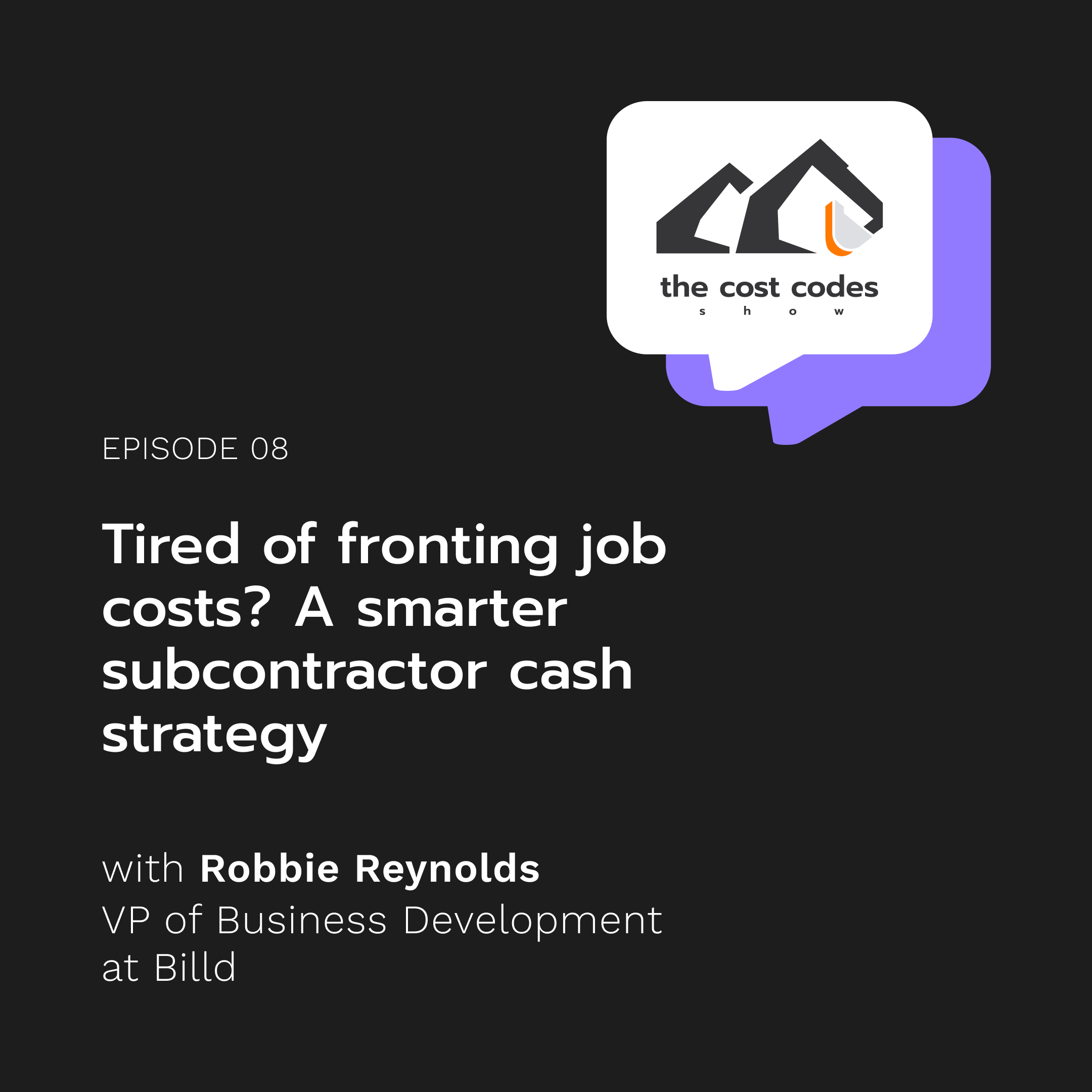
Cash flow is one of the biggest growth constraints trade contractors face — especially when they are expected to fund labor, materials, and job costs long before payment arrives. In this episode of The Cost Codes Show, Ryan Gilmore talks with Robbie Reynolds of Billd about why subcontractors often end up acting as the bank on construction projects, and what they can do to build a smarter liquidity strategy.
Together, they unpack the realities of long and unpredictable payment cycles, how contractors should think about capital stack planning, and why growth goals need to be tied to a clear understanding of cash needs. Robbie also shares practical guidance on when to use different financing tools, how to think about the cost of capital, where early pay programs and pay app advances fit in, and why contractors should plan for downside scenarios instead of assuming every project will go according to plan.
If you want a more intentional approach to working capital, financing, and cash flow planning in construction, this episode is full of practical insights you can put to use right away.
Plus, be sure to grab the free Capital Stack Toolkit and start building your working capital plan for the coming year: https://billd.com/resources/capital-stack-whitepaper/
Hello, everyone. Welcome to another episode of the cost code show presented by Noify. This is a podcast where we focus on helping trade contractors run and grow their businesses. Today, I'm excited to be joined by Robbie Reynolds, VP of corporate development at Build. Robbie has a ton of experience in the financing and cash flow management side of construction, and he's gonna share that with with us today. How are doing, Robbie? Great, Ryan. Thanks for having me. I've been a big fan of NoFi and and our partnership and, as well as the show. So excited to be here with you. Awesome, man. So for folks who don't know you yet, maybe you can talk a little bit about your background and how you got into construction and all that good stuff. Absolutely. I've been in commercial lending in one form or another my entire career. It started after college. I got into commercial banking, the private equity for a while, and then moved into equipment financing and then ultimately construction lending with Build. So my entire experience has been b to b lending and now with the emphasis on the working capital side of the equation. And then a little bit about Build. Build is a provider of working capital to the commercial construction industry. We focus specifically on this industry and specifically for the trades. We've got a seat suite of products that do solve for that. So, yeah, excited to talk about talk more about it here today. Awesome. So let's talk let's start with what I might call the elephant in the room. Let's walk through walk us through the situation subcontractors face as far as funding projects or being, quote, unquote, the bank for for projects. Yep. I think it really starts from how the industry is structured and the cash conversion cycle for subcontractor. When the cash conversion cycle the time from which you're outlaying cash to which you're actually recouping that in terms of getting paid from your customer. You know, there's different resources out there, but it can be anywhere from sixty to eighty, ninety days. And if you just start with that and stack it up against other industries, it's already at the top of the list. It's one of the longest cash conversion cycles out there. Secondly, construction is capital intensive, specifically for the trades. Something I always like to say is who's actually financing a construction project? Well, to the normal person you ask on the street, they'd probably say all the banks are financing. And I'd argue differently. The subs are financing the construction project, and they're being reimbursed, for work already completed by the owner and GC. So the subs are at the front of it. And there's a long cash conversion cycle capital intensive. They have to figure out a way to finance this to get their projects off the ground. So that's really what creates the problem. And then you add on top of that, it's a long sales it's a long conversion cycle. Excuse me. However, it's also unpredictable. So some projects you have thirty day terms, but the owner drags their feet, and that thirty day term ends up being a forty, fifty day payment. Other projects you sign up for might be a longer sixty, ninety day terms. Maybe on a public project that we're going in, it's gonna take longer to get paid. But even when you know what the payment terms are, there's no guarantee of when that's gonna come. And and, additionally, there's one weak link in the entire payment chain, if you will, that could slow the whole thing down. So you get your pay app in on time. GC reviews it, but the owner drags their feet. Okay. That still impacts you. And so that's something you have to manage through. Excellent. That's super helpful. So how does that kinda, like, long cash conversion cycle end up, you know, impacting subcontractors or maybe influencing the way they run their businesses? Yeah. To start with, it's something that the trades need to plan for. And there's, like, different ways that you can go about that, but it's critically important that you solve this equation and at least have a plan of attack so you can, one, weather storms, but two, grow your business. I think there's a lot out there who know what I'm talking about in their gut. There's times that they were low on cash, trouble making payroll, whatever it might be. And but they don't necessarily know how to bridge that to how much cash do I need. And so you tend to be pretty conservative with how much cash you wanna keep or maybe how you're choosing to grow your business to make sure you have enough cash. So I'd always say the number one thing is really about planning. And what I mean by planning is where is your business today and where are you trying to go? Because you need to back into how much cash does my business really need. So having a firm grasp on that in terms of where you wanna be this year, next year, three years from now, and working backwards is the first step, but having clear concrete goals of how you're gonna get there. And then once you have that in place and by the way, not everyone has necessarily the skill set. So I wanna just pause and say, if you don't feel like you know how to come up with that yourself, there's plenty of advisers, consultants out there who can help you with this. It could be your CPA. If you've got a controller CFO internally that might have the skill to do this, Build, we help customers with this all the time. Your banker might be able to help you out as well as third party consultants who would do this for a fee. I encourage you if you don't feel like you have the skills to do it, then to find someone to help you do this because it's a road map that you're creating that you're gonna continue to use year after year. So it's worth doing the right way. So the first step I'll be talking about, yeah, is really solving for what that is. If I'm if I'm a ten million dollar contractor today and over the next two years, I wanna be fifteen million, how much cash is that gonna take? What's the growth rate that I'm achieving I'm shooting for, and how quickly I wanna get there? And then the second piece is really breaking down the capital stack. And what do I mean by the capital stack? That's all of the different sources of cash. And the first step, we say, okay. In order to get to that fifteen million dollar mark, maybe I have. I'm just gonna make up numbers completely. These are probably not gonna tie in, but we're it's just an example. I wanna get to fifteen million over the next two years. And I know that in order to get from ten to fifteen, it's gonna require that I have three million dollars in liquidity available to me in order to get there. And so now that you know that number of three million, you're looking at your capital stack and say, okay. How much do I already have accounted for in this equation? And something that you are also solving for is what's my peak cash need. What do I mean by that? It's great to solve for what you need on any given day, but what you also have to be cognizant of is, okay. What's the biggest this cash gap could be? Assuming that we're hitting some of our growth trajectories and maybe we get some slower payments than expected, what's that relative range and be able to solve to know how you accomplish that as well. So you've got our cash needs, what the peak cash need would be, and we're backing into it. So the first one, obviously, is your cash. You should have cash, and you that's easy to figure out what it is. But you also can't have you need to have cash on the balance sheet. So you can't think of that as, oh, I can just deploy anytime. You need that as some of your buffer as well. You've got your lines of credit cards, supplier terms. There's other solutions such as build. And then something that's coming around, I would say, is really gaining momentum in the industry right now are GCs offering early pay programs. Some of your GCs might do that. It's just another lever you could pull to calculate and arrive at the amount of cash you need. So then you're gonna go through and figure out how much cash I have from each of these sources or availability, and you start backing into a plan of how do I get to that three million dollars. If I go through that and I've determined that I've only arrived at two million dollars in cash, then we need to solve for the delta, or you gotta rethink your growth plans, is really what the end of the day is. And you don't have to rethink your growth plans if you have the right consultant and the right strategy to go acquire that working capital that you would need. And then it's really going through each of those and seeing how I can access additional liquidity, to make sure I have sufficient cash. Nice. So as far as the capital stack is concerned, are there certain use cases that are more, like, appropriate for each of those different kind of capital sources? Like, kinda help maybe help some help a subcontractor who maybe isn't super familiar with all all those available options. Like, where would you wanna deploy credit cards versus a line of credit versus, you know, the cash that you might have in the bank? Yeah. That's a good question. So one, I would say, think about in terms of flexibility, and you want to, make sure you retain the flexibility where you need it. So cash and line of credit, those are the most flexible because you can draw on them to use for anything you want. And so you need to leave some of that aside. And then you would go to places like credit cards, for example. They can be good to use, but just you need to know what the cost is gonna be. And also know that it's not common you'll be able to solve that full need. That's good for your recurring business related expenses that you wanna defer a bit, but going and purchasing half a million dollars in materials on a credit card for most people is not feasible. So that's why you need to where you need to look at other sources. But, generally, you wanna reserve your most flexible options for when you need it and then go strategically deploy those other ones. So are you strategically using your supplier terms, negotiated the right terms? This is where also Bill can step in. We've got an offering for material financing where you can actually extend those those credit terms with suppliers from the thirty days to upwards of a hundred and twenty days, or a pay app advance where we could speed up the payment on those pay applications to a couple days after it's approved rather than the thirty to forty days. So you wanna go through that plan and then deploy it using those more difficult ones strategically and reserving the easier to use or access options for when you need it. Cool. Perfect. I think that's that's very, very helpful. So are there any kind of expenses that you would recommend, like, not funding with any of these kind of kind of tools? Like, just kinda trying to maybe help folks head off any potential mistakes they might make. Yeah. It's a good question. I would the biggest thing I've seen is just make sure that you are, and this is a little bit outside of the working capital conversation, but, like, you're using the right products, the right financing tools for the right use cases. Right? So I'll give an example of if you need a piece of equipment for your business, you should be thinking about, should I go pay cash for that, or should I consider maybe, like, an equipment financing option so I can preserve my cash for my working capital needs. Likewise, the credit cards should really be used for those ongoing business expenses, not those big project related purchases. And a line of credit can be pretty flexible because you can use it for anything in between. Nice. One other thing I'm I'm kinda curious about is, you know, there's a sort of a cost associated with some of these kinda capital sources as far as, you know, associated with it and things like that. How could a subcontractor go about kind of projecting those costs and baking that kind of cost of capital into their plans? So what you're getting at is a great point. And it's once you figured out your cash needs, you've understood your capital stack, and you have a plan in place for what percentage of my liquidity am I gonna draw from each of these options in my capital stack, you can then figure out what is my cost of capital. Right? What is my financing cost? And you should know that because this is a tight margin business. And if you're not accounting for the cost of your capital in your bids, then you're doing yourself a disturbance. There is a direct cost for materials. There's a direct cost for labor. There's also direct cost for money. Most most contractors we speak with do not think about including their financing cost within their bid. But the ones who grow and grow profitably know that this is a key element of it if they're gonna be using financing to to achieve that growth. So, again, this is something we highly recommend after going through that capital stack exercise is taking that into the bidding process and accounting for your cost of capital. If I know I'm gonna use a certain type of financing on this project, then let's make sure we include that to where we are protecting our margins at all costs. Perfect. Maybe along those lines, you know, there's a lot of options as far, if you take credit cards, for example, like, there's, you know, quite quite a lot of options available. Do you have any kind of, like, rules of thumb you might be able to provide as far as, like, knowing this is a great this is a good lender to work with or this is a good, you know, source of capital for for this Yeah. Category, if that makes sense. One, I would say take a look at the lender and their area of expertise. You know, I'm gonna stick credit cards to the side here because I'm just not a proponent of that being a core part of your financing strategy. They're just not designed to be. But if you talk about working with a lender who's someone who's gonna support your business and provide you working capital, whether that's a a line of credit, maybe it's a a factoring company, maybe it's a build type, maybe it's someone else. But what do they specialize in? Because lenders will generally have an area of focus, and making sure that they understand construction and they have other construction clients is really important because that's gonna reflect how they view you, the types of terms and covenants that they put in place, and how difficult it is gonna be to obtain financing in the good times and then how understanding they're gonna be in the difficult times. Right? Someone who doesn't understand construction, which you can get on a tight spot with, if let's say you've gotten a line of credit who's not from a bank, who's not big into construction, and construction starts slowing down, they get spooked, and all of a sudden, your line of credit goes away. So I'd say the lender's expertise. And then two, you do need multiple options. Right? You can't just rely on one. You need to set up these options ahead of time, and it's before you need it. The best time to ask for a loan is when you don't need the loan. So you should always be thinking about in the good times, I should be asking for credit now. So it's already set up when you need it. Because when you come to a lender and you're desperate and you're running out of cash, you need a loan now, it's much more difficult to get it. Yeah. That makes a ton of sense. Have you seen situations, just curious, where, like, you know, having having these tools in place can help, subcontractor win business or or maybe appear more, like, trustworthy to a GC, like, knowing you have x, you know, hundred thousand doll you know, hundred thousand dollars of of credit available to you, that kind of thing. Yeah. It absolutely comes into play. One, it impacts your prequalification process with GCs. They are absolutely looking at how much liquidity you have. Are they looking at cash on hand, also unfunded commitments? Same with your bonding. Alright? When you need to get bonding, one of the biggest things they look at in their underwriting is liquidity and unfunded commitment. So having those in place and improving that you can weather storms is gonna give you a leg up. Right? Especially in a competitive competitive process where you're up against a handful of other trades for a job. Your ability to, one, you have your track record, but two, to financially show them how strong you are makes a big difference knowing that you're gonna you're gonna execute the way you say you are. Perfect. Is there any kind of rule of thumb you might have for, like, reevaluating kind of your capital stack? Like, is it something you might wanna do, like, every six months, every year, that kind of thing? I'd say at least annually, you should be looking at it. To expand on that with whoever your finance team might be, if you have a CFO controller or using a consultant or just you should be keeping a tabs on what that access is, how much you have drawn down at least monthly. But you should be then reassessing it annually of, okay. Where am I going this upcoming year? I've got these sources of liquidity. Is it gonna get me to where I wanna go, and do I need to reassess? Perfect. That makes a ton of sense. I wanted to now maybe jump just into, like, the more specific component of the capital stack, which was the early pay programs Yeah. You talked about. Could you maybe explain what those are in a little bit more detail, where they fit in the capital stack, like, when they're a good idea to use, when you might not need them, that kind of thing? Yep. No. It's so we are intimately aware of this. We actually work with GCs to help them facilitate early pay programs, and we've seen a lot more GCs offering this. Effectively, what that is, it's a programmatic way for subs to get paid early on their project with that GC. Typically, how it would work is you would follow the same submission, requirements that you do today. Let's say you're submitting by the twenty fifth. You provided all your compliance documents, and the GC is approving internally. And then you would able would be able to get paid by, we'll call it, the first and the third of the month. So, generally, that equates to thirty, thirty five days early, and they're pretty flexible. You can either take this on one pay application or sign up for an entire project. But it's a really great way to to improve the liquidity in your business, and it does not impact your other financing sources. Technically, it's not borrowing, so it would not impact your line of credit or how you work with suppliers or even build. It's just another liquidity lever. And so I know there's a lot of listeners on the show here. I would encourage you to ask your GCs, if this is something they offer or if they've considered it for two two reasons. One, they might and you just might not be aware of it. And two, the more they hear that from y'all, the more likely they are to go engage with the program and start offering one. And it's really a win win for the industry. So I would highly encourage the group here to ask your VCs about that and also feel free to reach out to us. We could help you formulate that conversation as well. Cool. I think it's I think at least it's a similar type of product along similar lines, but we have a lot of listeners and and nullifies a lot of customers that are, you know, doing AIA projects involving AIA pay applications. And I know that you've talked in the past about pay app advances. Could you maybe do the same thing where you kinda explain you you might probably it's obvious a little bit obvious what they are, but, like, maybe explain what they are and where those would fit in into the equation and any kind of pros or cons of those? Yeah. A hundred percent. So the payoff advance is similar to that early pay, but it's not offered through the GC. You would just work with Bill directly. So when you have an approved but unpaid invoice, you could come to bill, then we would advance you up to a hundred percent of that pay application, as soon as it's approved. And once you get paid from the GC, you turn around and pay bill back. So it's just another tool that you can use to speed up the receivables, improve your cash and your cash flow, and it's completely flexible in terms of it's you can use it as you need it. Right? There's no requirement that you have to go use it on an entire project or x percent of your business. It's a very flexible tool that allows you to control your cash flow pretty easily. So that we generally would encourage for general g and a expenses, labor cost. If you have a big project coming up, you need to free up some cash flow. All those would be great use cases. It could be a part of the planning process. Right? I need to use a product like that on twenty percent of my projects in order to meet my cash flow goals the next year. I see. I like the idea of integrating it into the into the kind of the planning process upfront. As far as all of this all of the kind of financing stuff is concerned, what's kinda, like, the biggest mistake that you see subcontractors make? Like, what are some kind of things they can do to prevent that or make sure this stuff kinda works out the way they plan that it's gonna work out? Assuming it's all gonna go as expected. Right? I think it's obvious, but are you planning for the contingencies, the downside, and knowing what the relative range of cash needs is gonna be? Not just the this is my best my my base case band here of what I'm gonna need and just planning for that. So maybe two part answer, making sure you're actually planning for it, and two, knowing what the downside scenario is and that you're able to weather that storm. Cool. Perfect. I like that. I'm always planning. I was planning for the worst. Hope for the best, plan for the worst. Right? There you go. So we're getting kinda closer to the close to the end of the convo. So one last question from me before I give you a chance to talk a little bit more about Build and what you all do is, you know, we we like this podcast to be, like, really action actionable. So if there was, like, a subcontractor listening today that was starting to think, you know, about cap their capital needs and planning and things like that, like, what would be kind of the first thing they could do, you know, next week to to get the ball rolling and and immediately start to kinda integrate some of this stuff into their business plan and and their execution and things like that? Great question. I would say the most immediate things would be looking at my backlog, my pipeline of what I have coming and taking stock of my liquidity today. And if even if it's just a gut feel of, do I have enough? Go take the action of starting that relationship with a capital provider because these things don't happen overnight. So just get that ball rolling. Pick up the phone. We'd be happy. And, also, the build team does do this. We can help you come up with that assessment to determine how much cash you're gonna need. I would say so if there's one thing, I'd say do the assessment. Do your own internal assessment of how much cash I need, and then you can put together an action plan from there, and we'd be happy to help for those who need it. Nice. So, yeah, maybe you can just share a little bit more about build for the audience, what y'all do, and and where they can learn more about you guys and take and, you know, reach out if they would like to. Yeah. Absolutely. So we talked a little bit about this. We are the nation's largest working capital provider that focuses specifically on commercial subs. We've got a suite of working capital products that are very flexible to use, all designed around improving cash flow and enabling subs to grow their business. That's all we do every single day. We are intimately aware of this industry, the needs unique needs of construction, and are here to support it. So that's what we do every day. To get in touch, I'd say feel free. You can shoot me an email. It's r o b b I e at Build dot com, or go to our website, and there's a couple of places that you can reach out there. It's w w w dot b I l l d dot com. That'd be the two easiest ways to get in touch, and someone will follow-up with you shortly. Nice. And, Robbie and the bill team have been kind enough to provide a working capital toolkit, which is like a downloadable guide that kinda walks through a lot of the different topics that we covered today. I know it's it can be kind of a lot to take in just listening or watching us. So good to have a hard copy you can reference. We'll link that in the show notes for y'all to reference. I think that about wraps it up. So, Robbie, thanks for, you know, taking the time to talk to us and the CostCoat show audience. Definitely check out Build if y'all are interested. And if you need help managing your construction projects or your construction financials, please check out Knowify at w w w dot knowify dot com. We'll be back with another episode of the Cost Code Show soon. Thank you.
Ryan Gilmore:
Hello everyone, and welcome to another episode of The Cost Code Show, presented by Knowify. This is a podcast where we focus on helping trade contractors run and grow their businesses.
Today, I’m excited to be joined by Robbie Reynolds, VP of Corporate Development at BILLD. Robbie has a ton of experience in the financing and cash flow management side of construction, and he’s going to share that with us today.
Robbie, how are you doing?
Robbie Reynolds:
Great, Ryan. Thanks for having me. We’ve been a big fan of Knowify, our partnership, and the show as well, so I’m excited to be here with you.
Ryan Gilmore:
Awesome, man. For folks who don’t know you yet, maybe you can talk a little bit about your background and how you got into construction and all that good stuff.
Robbie Reynolds:
Absolutely. I’ve been in commercial lending in one form or another my entire career. It started after college when I got into commercial banking. I was in private equity for a while, then moved into equipment financing, and ultimately construction lending with BILLD.
So my entire experience has been in B2B lending, and now there’s a big emphasis on the working capital side of the equation.
A little bit about BILLD: we’re a provider of working capital to the commercial construction industry. We focus specifically on this industry and specifically on the trades. We’ve got a suite of products that solve for that, so I’m excited to talk more about it here today.
Ryan Gilmore:
Awesome. Let’s start with what I might call the elephant in the room. Walk us through the situation subcontractors face when it comes to funding projects or being, quote unquote, “the bank” for projects.
Robbie Reynolds:
Yeah, I think it really starts with how the industry is structured and the cash conversion cycle for the subcontractor.
The cash conversion cycle is the time from when you’re laying out cash to when you’re actually recouping it by getting paid from your customer. Depending on the source, that can be anywhere from 60 to 80 or even 90 days. If you compare that with other industries, construction is already near the top of the list as one of the longest cash conversion cycles out there.
Construction is also capital intensive, especially for the trades. Something I always like to say is: who’s actually financing a construction project? If you asked the average person on the street, they’d probably say the banks are financing it. I’d argue differently. The subs are financing the construction project, and then they’re being reimbursed for work already completed by the owner and GC.
So the subcontractors are out front, and with this long cash conversion cycle, they have to figure out how to finance projects just to get them off the ground. That’s really what creates the problem.
Then you add on top of that the fact that it’s not only a long cycle, but an unpredictable one. Some projects might have 30-day terms, but then the owner drags their feet and that turns into 40 or 50 days. Other projects might start with 60- or 90-day terms, especially on a public job, where you know going in that it’ll take longer to get paid.
But even when you know the payment terms, there’s no guarantee of exactly when payment will come. There’s one weak link in the payment chain that can slow the whole thing down. You get your pay app in on time, the GC reviews it, but the owner drags their feet — that still impacts you. That’s something subcontractors have to manage through.
Ryan Gilmore:
Excellent. That’s super helpful. How does that long cash conversion cycle impact subcontractors or influence the way they run their businesses?
Robbie Reynolds:
To start with, it’s something the trades need to plan for. There are different ways you can go about that, but it’s critically important that you solve this equation so you can, one, weather storms, and two, grow your business.
A lot of contractors know what I’m talking about in their gut. There have been times when they were low on cash, had trouble making payroll, whatever it might be. But they don’t always know how to bridge that feeling into a concrete answer to the question: how much cash do I actually need?
Because of that, they tend to be conservative — conservative with how much cash they want to keep on hand, or conservative in how they grow the business — just to make sure they have enough liquidity.
So I’d say the number one thing is planning. And what I mean by planning is understanding where your business is today and where you’re trying to go, because you need to back into how much cash your business really needs.
If you don’t feel like you know how to come up with that yourself, there are plenty of advisors and consultants who can help. It could be your CPA, your controller or CFO internally, your banker, or a third-party consultant. BILLD helps customers with this all the time as well.
It’s worth doing the right way because what you’re creating is a roadmap you can continue to use year after year.
Robbie Reynolds:
The first step is solving for what your cash need is.
If I’m a $10 million contractor today and over the next two years I want to get to $15 million, how much cash is that going to take? What growth rate am I aiming for, and how quickly do I want to get there?
Then the second piece is really breaking down the capital stack. By capital stack, I mean all the different sources of cash available to you.
Let’s say you determine that in order to get from $10 million to $15 million, you need $3 million in liquidity available to you. Once you know that number, you can start looking at your capital stack and ask: how much of that is already accounted for?
You also have to solve for your peak cash need. It’s great to know what you need on any given day, but you also need to know what the largest possible cash gap could be — assuming you hit some growth targets and maybe payments come in slower than expected.
So you’ve got your cash needs, your peak cash need, and now you start backing into the plan.
The first source is obviously your cash. That’s easy to identify, but you also can’t assume all cash on the balance sheet is deployable at any time. You need some of that as a buffer.
Then you’ve got lines of credit, credit cards, supplier terms, and other solutions like BILLD. Another thing gaining momentum in the industry right now is early pay programs offered by GCs. Some of your GCs may already offer that.
So once you’ve figured out how much liquidity each of those sources provides, you can back into a plan for how to get to your target. If you go through that exercise and determine that you’ve only got $2 million available but you need $3 million, then you have to solve for that delta — or rethink your growth plans.
And really, you may not have to rethink your growth plans if you’ve got the right consultant and the right strategy. You may just need to go acquire the working capital you need.
Ryan Gilmore:
As far as the capital stack is concerned, are there certain use cases that are more appropriate for each of those different capital sources? Maybe that would help subcontractors who aren’t super familiar with all the available options.
Where would you want to deploy credit cards versus a line of credit versus the cash that you might have in the bank?
Robbie Reynolds:
Yeah, that’s a good question. I’d say think about it in terms of flexibility.
Cash and a line of credit are your most flexible tools because you can draw on them for almost anything. So you want to preserve some of that flexibility for when you really need it.
Credit cards can be useful, but you need to know what the cost will be, and you need to know they usually won’t solve the full need. They can be good for recurring business-related expenses that you want to defer a little bit. But buying half a million dollars in materials on a credit card is not feasible for most people.
That’s where you need to look at other sources.
In general, you want to reserve your most flexible options for when you need them, and strategically deploy the others. Are you using supplier terms effectively? Have you negotiated the right terms? That’s where BILLD can step in, too.
We offer material financing that can extend supplier terms from 30 days to as much as 120 days, or a pay app advance that can speed up payment on approved applications to just a couple of days instead of waiting 30 to 40 days.
So the idea is to go through that plan, use the more specialized tools strategically, and preserve your easiest, most flexible options for when you really need them.
Ryan Gilmore:
Perfect. I think that’s very, very helpful. Are there any expenses you would recommend not funding with these kinds of tools? Just trying to help folks avoid mistakes.
Robbie Reynolds:
Yeah, it’s a good question. The biggest thing I’ve seen is making sure you’re using the right financing tools for the right use cases.
For example, if you need a piece of equipment for your business, you should be thinking about whether you want to pay cash for that, or whether an equipment financing option makes more sense so you can preserve your cash for working capital needs.
Likewise, credit cards should really be used for ongoing business expenses, not large project-related purchases. And the line of credit can be pretty flexible because you can use it for a lot of different things in between.
Ryan Gilmore:
One other thing I’m curious about is that there’s obviously a cost associated with some of these capital sources — interest and things like that. How can a subcontractor project those costs and bake that cost of capital into their plans?
Robbie Reynolds:
That’s a great point.
Once you’ve figured out your cash needs, understood your capital stack, and decided what percentage of your liquidity is going to come from each of those sources, you can start figuring out your cost of capital — your financing cost.
And you should know that, because this is a tight-margin business. If you’re not accounting for the cost of capital in your bids, then you’re doing yourself a disservice.
There’s a direct cost for materials. There’s a direct cost for labor. There’s also a direct cost for money.
Most contractors we speak with do not think about including financing costs in their bids. But the ones who grow — and grow profitably — understand that this is a key element, especially if they’re using financing to support that growth.
After going through the capital stack exercise, we highly recommend taking that next step in the bid process and accounting for your cost of capital. If I know I’m going to use a certain type of financing on this project, then let’s make sure we include that so we can protect margins at all costs.
Ryan Gilmore:
Along those lines, there are a lot of options out there. If you take credit cards, for example, there are quite a few available. Do you have any rules of thumb for knowing this is a good lender to work with, or this is a good source of capital for a certain category?
Robbie Reynolds:
I’d say take a look at the lender and their area of expertise.
I’ll stick credit cards to the side because I’m just not a proponent of them being a core part of your financing strategy. They’re just not designed for that.
But if you’re talking about a lender that’s going to support your business and provide working capital — whether that’s a line of credit, a factoring company, BILLD, or someone else — ask what they specialize in.
Lenders generally have an area of focus. Making sure they understand construction and have other construction clients is really important. That’s going to affect how they view your business, the terms and covenants they put in place, and how difficult it will be to obtain financing in both good times and hard times.
Someone who doesn’t understand construction can put you in a tight spot. For example, say you’ve gotten a line of credit from a lender that isn’t really experienced in construction. If the construction market starts slowing down, they may get spooked, and suddenly your line of credit goes away.
So lender expertise matters.
And second, you do need multiple options. You can’t rely on just one. You need to set these options up ahead of time — before you need them.
The best time to ask for a loan is when you don’t need one. You should always be thinking, in the good times, that now is when I should be asking for credit so it’s already in place when I need it. Because when you come to a lender desperate and short on cash, it’s much harder to get financing.
Ryan Gilmore:
That makes a ton of sense. Have you seen situations where having these tools in place can help a subcontractor win business or appear more trustworthy to a GC? For example, knowing you have $100,000 or more of credit available.
Robbie Reynolds:
Yeah, it absolutely comes into play.
First, it impacts your prequalification process with GCs. They are absolutely looking at how much liquidity you have. They’re looking at cash on hand and also unfunded commitments.
The same goes for bonding. One of the biggest things they look at in underwriting is liquidity and unfunded commitment. So having those in place and being able to prove that you can weather storms gives you a real advantage.
Especially in a competitive process where you’re up against a handful of other trades for a job, your ability to show financial strength — in addition to your track record — makes a big difference.
Ryan Gilmore:
Do you have a rule of thumb for how often a subcontractor should reevaluate their capital stack? Every six months? Every year?
Robbie Reynolds:
I’d say at least annually.
And to expand on that, whoever your finance team is — whether that’s a CFO, controller, consultant, or just you — should be keeping tabs monthly on how much access you have and how much you’ve drawn down.
But at least once a year, you should be reassessing: where am I trying to go this upcoming year, what sources of liquidity do I have, will that get me where I want to go, and do I need to reassess?
Ryan Gilmore:
Perfect. That makes a ton of sense. I want to jump into one of the more specific components of the capital stack, which is early pay programs.
Could you explain what those are in a little more detail, where they fit in the capital stack, and when they’re a good idea to use?
Robbie Reynolds:
Yeah. We’re intimately aware of this because we actually work with GCs to help them facilitate early pay programs, and we’ve seen a lot more GCs offering them.
Effectively, it’s a programmatic way for subs to get paid early on their projects with that GC.
Typically, you’d follow the same submission requirements you do today. Let’s say you submit by the 25th and provide all your compliance documents. The GC approves things internally, and then you’d be able to get paid by, say, the first or third of the month.
Generally, that equates to getting paid 30 to 35 days earlier.
They’re also pretty flexible. You can use them on a single pay application or sign up for an entire project.
It’s a really great way to improve liquidity in your business, and it doesn’t impact your other financing sources. Technically, it’s not borrowing, so it doesn’t affect your line of credit, your supplier relationships, or even BILLD. It’s just another liquidity lever.
So for those listening, I’d encourage you to ask your GCs whether they offer this or have considered it — for two reasons. One, they might already offer it and you just don’t know. Two, the more they hear that from subcontractors, the more likely they are to implement a program.
It’s really a win-win for the industry. And if you want help figuring out how to have that conversation, feel free to reach out to us.
Ryan Gilmore:
Cool. I think that’s a similar type of product, but we’ve got a lot of listeners — and a lot of Knowify customers — who are working on projects involving AIA pay applications. I know you’ve talked in the past about pay app advances.
Could you explain what those are, where they fit into the equation, and some of the pros and cons?
Robbie Reynolds:
Yeah, absolutely.
A pay app advance is similar to early pay, except it’s not offered through the GC. You work directly with BILLD.
When you have an approved but unpaid invoice, you can come to BILLD and we can advance up to 100% of that pay application as soon as it’s approved. Then once you get paid by the GC, you pay BILLD back.
It’s another tool you can use to speed up receivables and improve your cash flow.
It’s also very flexible. You can use it as needed — there’s no requirement to use it for an entire project or a certain percentage of your business. It gives you control over your cash flow in a pretty straightforward way.
We generally encourage using it for general G&A expenses, labor costs, or if you have a big project coming up and need to free up cash flow. It can absolutely be part of the planning process. You might determine that you need to use a product like that on some of your projects in order to hit your cash flow goals for the year.
Ryan Gilmore:
I like the idea of integrating it into the planning process upfront.
Ryan Gilmore:
As far as all of this financing stuff is concerned, what’s the biggest mistake you see subcontractors make? And what are some things they can do to prevent it?
Robbie Reynolds:
The biggest mistake is assuming everything is going to go as expected.
Are you planning for contingencies? Are you planning for the downside? Do you understand the range of cash needs you might have — not just your base case, but what happens if things don’t go according to plan?
So I’d give a two-part answer: one, make sure you’re actually planning for it. Two, make sure you know what the downside scenario looks like and that you’re in a position to weather that storm.
Ryan Gilmore:
Cool. Perfect. I like that. Hope for the best, plan for the worst, right?
Robbie Reynolds:
There you go.
Ryan Gilmore:
We’re getting close to the end of the conversation, so one last question from me before I give you a chance to talk a little more about BILLD.
We like this podcast to be really actionable. So if there’s a subcontractor listening today who’s starting to think about their capital needs and planning, what’s the first thing they could do next week to get the ball rolling and start integrating some of this into their business plan?
Robbie Reynolds:
Great question.
I’d say the most immediate thing would be looking at your backlog and your pipeline — what you’ve got coming — and taking stock of your liquidity today.
Even if it’s just a gut check of “Do I have enough?”, go take the action of starting a relationship with a capital provider, because these things don’t happen overnight.
So just get the ball rolling. Pick up the phone. We’d be happy to help, and the BILLD team can help you come up with an assessment to determine how much cash you’re going to need.
If there’s one thing I’d recommend, it’s this: do the assessment. Do your own internal assessment of how much cash you need, and then you can put together an action plan from there.
Ryan Gilmore:
Nice. Maybe you can share a little more about BILLD for the audience — what y’all do, where they can learn more, and how they can reach out if they’d like to.
Robbie Reynolds:
Yeah, absolutely.
As we talked about a little bit earlier, we are the nation’s largest working capital provider focused specifically on commercial subcontractors. We’ve got a suite of very flexible working capital products designed around improving cash flow and enabling subs to grow their businesses.
That’s all we do every single day. We are deeply familiar with this industry and the unique needs of construction, and we’re here to support it.
To get in touch, feel free to shoot me an email at robbie@billd.com, or go to our website at www.billd.com. Those are probably the two easiest ways to reach us, and someone will follow up with you shortly.
Ryan Gilmore:
Nice. And Robbie and the BILLD team have been kind enough to provide a working capital toolkit — a downloadable guide that walks through a lot of the topics we covered today. I know it can be a lot to take in just by listening or watching, so it’s nice to have a hard copy you can reference.
We’ll link that in the show notes for you all.
I think that about wraps it up. So Robbie, thanks for taking the time to talk to us and the Cost Code Show audience. Definitely check out BILLD if you’re interested.
And if you need help managing your construction projects or your construction financials, please check out Knowify at www.knowify.com.
We’ll be back with another episode of The Cost Code Show soon. Thank you all.