Intuit Enterprise Suite (IES) is a strong accounting platform, and in 2026 Intuit added construction features to it. Contractors running several entities are getting value out of that, and they say so publicly.
“Intuit Enterprise Suite has helped us consolidate our multiple construction businesses into one uniform platform… consolidated reports are available in moments that allow us to focus our attention on key business decisions.” – Bjorn “Hayden” Croxall, President, Croxall Construction Companies. 10/10 on TrustRadius, January 2026. Construction industry reviewer.
Contractors running a single entity tend to land somewhere else
“If you are currently using QBO and have one or maybe two instances the upgrade may not be worth the cost.” – Michael Panster, President, Servpro of Ft Lauderdale. 8/10 on TrustRadius, November 2025. Construction industry reviewer.
Both of those are construction reviewers talking about the same platform, and the gap between them is an interesting story. IES works as a multi-entity accounting system. It does not run construction operations, so pay applications, retention, field progress, service calls, and prevailing wage rates sit either outside IES or inside it as manual work.
Every product claim here traces to Intuit’s own release notes, help docs, press releases, or to RedHammer, one of Intuit’s preferred construction implementation partners (and a Knowify-certified firm). Review claims trace to a named reviewer on G2, TrustRadius, or Gartner Peer Insights, with the score and date. Where a construction workflow has no documentation at all, we say that plainly instead of guessing. Everything was checked as of August 1, 2026.
Knowify is an Intuit partner, QuickBooks Solutions Provider, and was one of just two platforms to integrate with Intuit Enterprise Suite at launch. This is written for the contractor trying to work out which tool does what, not as a pitch for either one.
IES is a finance-led, multi-entity accounting and ERP platform. It is not a construction operations platform. The consolidation side is strong if you run several entities (for example, an equipment rental company and an excavation company that rents said equipment). The construction side is in open beta, and the day-to-day operating work either happens by hand or happens in another system.
Intuit’s own answer to that is integration. Its construction page points contractors to Procore, Buildertrend, ServiceTitan, JobTread, Knowify, BigTime, and Houzz Pro.
So the question that matters is whether you need what IES is good at:
Intuit Enterprise Suite (or IES, for short) is Intuit’s cloud accounting platform for mid-market businesses that don’t need a full ERP like NetSuite, Sage Intacct, or Microsoft Dynamics, but are looking for a platform that scale beyond some of the limitations of QuickBooks Online. Intuit launched it on September 17, 2024 and has shipped new features or enhancements every three to four months since.
It runs on QuickBooks Online’s infrastructure, but it is a separate product (Not a QBO plan tier, and not a cloud version of QuickBooks Desktop Enterprise). Intuit puts it between QuickBooks Online Advanced and a full ERP.
Revenue range:
Intuit does not publish a recommended revenue range for Intuit Enterprise Suite, but Intuit partners have put numbers on it: Certum Solutions describes the fit as “generally $5 million to $250 million in annual revenue” (July 2026)
Launch materials for the platform say “larger, mid-market businesses who have more complex business needs as they scale,” and Intuit’s May 2026 announcement talks about operations getting more complex as businesses grow.
Number of entities:
On scale, Intuit’s May 13, 2026 announcement says IES is “capable of managing 200+ entities and millions in revenue,” and Intuit’s site cites a Diocese of Brooklyn customer with “260+ entities managed on one platform.” Two partners put the user ceiling at 500.
Managing multiple companies is one of the most impactful capabilities Intuit Enterprise Suite offers. Manage multiple entities in one platform, switch entities from a dropdown, and run consolidated Balance Sheet, P&L, Cash Flow, and Trial Balance. Intercompany transactions are made simple – eliminations happen automatically at the transaction level (announced in the Spring 2026 release and available in the first half of June 2026). Account-level dynamic allocations split a balance like insurance or home-office rent across entities at month-end. Revenue recognition by milestone and percentage-of-completion is built in.
Intuit Enterprise Suite replaces QuickBooks’ single Class field with Dimensions. Intuit advertises “up to 20 customizable dimensions,” and more than one dimension can sit on a single transaction. Dimensions also allow a hierarchy with up to five levels of sub-values. As of August 2026, Knowify is one of just a few platforms that integrate directly with Dimensions.
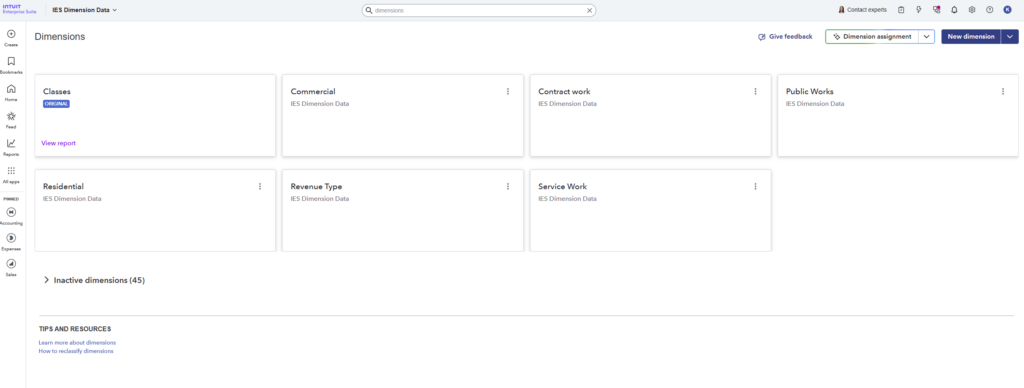
For comparison, QuickBooks Online gives you one class dimension, assignable either to the whole transaction or to each line, plus one location. That’s the ceiling. An agentic workflow maps up to five years of historical class data over to dimension values.
IES bundles purpose-built agents rather than one chatbot. Intuit’s October 2025 announcement named eight: Sales, Payroll, Customer, Payments, Finance, Project Management, Accounting, and Sales Tax.
Intuit is also rolling out Intuit Intelligence, a built-in AI and business intelligence platform integrated into QuickBooks Online and the Intuit Enterprise Suite. It connects your accounting, payments, and payroll data to find gaps in data, and answer questions about the business. As of August 2026 it carries a beta disclaimer and a monthly capacity cap per account.
In May 2026 Intuit rebranded its whole payroll lineup as QuickBooks Workforce (Payroll, Premium, Elite), built partly on acquired GoCo HCM technology. Workforce Elite adds recruiting and applicant tracking. It also adds Checkr background checks as an add-on, guided onboarding, HR workflows, document storage and e-signature, performance reviews, time-off management, offboarding, an HR advisor through Mineral Inc., and QuickBooks 401(k) by Vestwell.
Intuit calls it the biggest change to its HCM capabilities since QuickBooks Online launched, and they’ve changed the name of their longstanding product accordingly. For a labor-heavy contractor there’s serious value here, but it’s an HR platform rather than a construction feature.
Added in Spring 2026 and flagged as beta, this shows “how performance compares across industry, revenue band, and location, drawn from the actual transaction data of millions of real businesses.” Very few construction platforms do anything like this, and for folks in a hyper-competitive space, this is a really valuable feature.
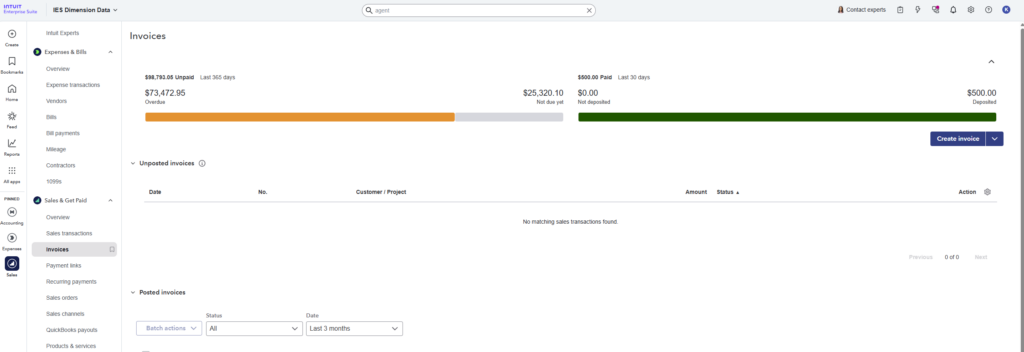
Intuit Enterprise Suite offers built-in invoicing, bill pay with autopay for recurring bills, and instant payment (for a fee). IES also includes Mailchimp, with campaign and customer journey builders and AI-generated content across email and SMS.
Intuit announced IES Construction Edition on February 11, 2026, calling it “Intuit’s first industry-specific ERP.” It expanded in the Spring 2026 release on May 13.
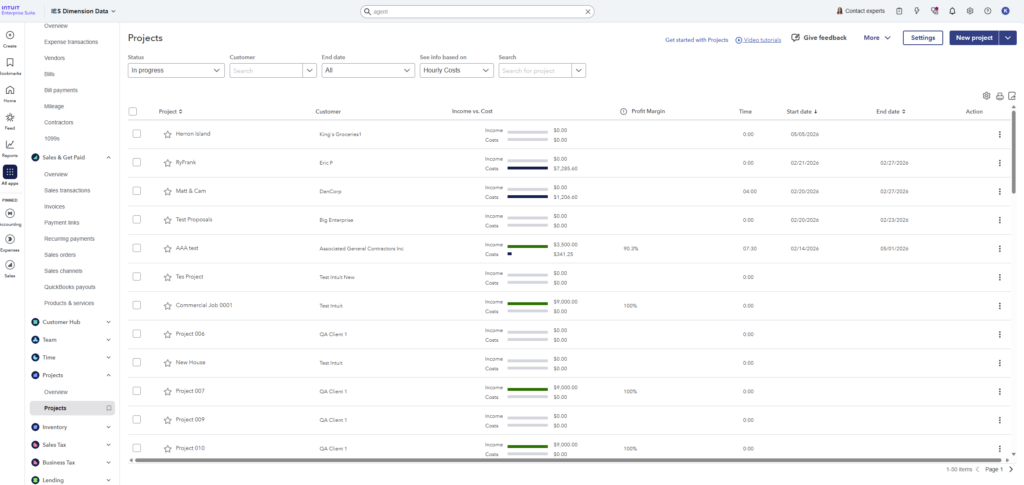
Here’s what’s in it as of August 2026:
RedHammer adds that Revised Contract Value, meaning original contract value plus approved change orders, is now a core WIP metric, and that over and under billing shows up directly in the report.
That’s a substantial list, and some contractors are running projects on it happily.
“The project management tools within the system are very robust, allowing us to track many specific details with extreme accuracy, which is crucial for our engineering and construction company. This reduces the time needed for us to track things and increases the accuracy of those things, making us more profitable and efficient.” – Chad S., Planner, Small-Business. 5.0/5 on G2, July 2026. Construction industry reviewer.
Others in construction describe the opposite experience with the same module.
“Projects functionality is full of bugs and works very poorly.” – Verified User, Executive in Finance and Accounting, construction, 11-50 employees. 1/10 on TrustRadius, April 2026.
We’re showing you both because both are on the record, and because a $6.5 million construction services company and an engineering firm are not the same buyer.
The construction capabilities are still in open beta for IES customers. Intuit’s own beta language in the February 2026 release notes is that features in beta are “subject to change or discontinue at any time, and Intuit may introduce fees or other pricing requirements for such features in the future.”
The same capabilities are generally available as a paid add-on for QuickBooks Online Advanced customers. So “beta” describes the IES path, not every path.
RedHammer implements Intuit Enterprise Suite and other products for construction clients. Their read, published February 11, 2026 and updated May 5, 2026: “WIP reporting, retention tracking, and certified payroll are areas where dedicated construction platforms like Foundation and Sage have deeper functionality.” Followed by some sound advice: “Evaluate whether IES covers your specific requirements.”
**Two of the three above have moved since the article was last updated. WIP got Revised Contract Value and over/under billing in Spring 2026, and WH-347 certified payroll shipped in May 2026. Retention tracking has not changed, to the best of our knowledge.
RedHammer also publishes a list headed “RedHammer Wish List for the Next Release,” introduced with: “The Spring 2026 release closed real gaps. Here is what we are advocating for next based on what we see in client environments every day.”
That’s their advocacy list, not a roadmap. Intuit has published nothing confirming any of it, and RedHammer’s own framing is that they’ve shared it with Intuit and expect WIP to keep evolving release over release. As of May 11, 2026 they’re asking for:
This matters most to contractors coming off Desktop. Certum Solutions, writing in July 2026, says IES “currently does not include”:
Certum also says IES “is not built for product-based or inventory-heavy businesses.”
Longer gap lists circulate online, pointing out multi-site and bin management, sub-assembly builds, the inability to disallow negative inventory, and landed-cost allocation. We’re citing the four Certum confirms this year and flagging the rest as widely reported but sourced to older write-ups. If inventory depth is central to your business, get your Intuit rep to confirm each item in writing.
What IES did add: item receipts in February 2026, and the option for QuickBooks Desktop migrators to keep Moving Average Cost valuations instead of switching to FIFO. That MAC option is migration preservation for Desktop converts, not a general costing choice. Purchase orders, sales orders, and estimates are all present, and sales orders now connect to POs, estimates, and invoices.
Intuit does not publish IES pricing. No price list, no tiers, no seat counts, no self-serve signup. Intuit’s pricing page says it will “collaborate with you to craft a product bundle and agreement that reflects your business, user needs, and preferred Intuit solutions,” and gives you a phone number.
Based on market feedback, quotes seem to depend on entity count, seat count, and which modules and integrations you turn on. Implementation is usually separate, though Intuit’s migration page says implementation is “fully included for QuickBooks Desktop customers, a $9,000 value,” and that dedicated Intuit implementation consultants manage the migration start to finish.
Sourced from Intuit’s own release notes. Intuit’s naming is inconsistent, some releases branded by month and some by season, so both appear below.
September 17, 2024 (launch). Multi-entity navigation and centralized users, up to 20 dimensions, change orders with approval, revenue recognition by percentage-of-completion and milestone, a project dashboard and Project Manager role, construction reports, and payroll cost allocation.
December 2024. Manual eliminations and consolidated Balance Sheet, P&L, Cash Flow, and Trial Balance, cross-entity user visibility, recurring customer payments, an AI 1099 service, dimensions in bank feeds, Spreadsheet Sync, and granular report permissions.
Spring 2025 (April 1). Percentage-based multi-entity allocations, a multi-entity hub, entity-selectable consolidated reporting, AI-assisted budgets, task and cost-code templates, a third-party API, dimensional P&L forecasts, and org charts.
Summer 2025 (July 22). The first four AI agents (Accounting, Payments, Finance, Project Management), more than 30 pre-defined KPIs, AI cash-flow forecasting, 3-way financial planning, deposits on estimates, an employee cost-rate calculator, and global natural-language search.
Fall 2025 (November 14). More agents, a role-based Consolidated View, account-level dynamic allocations, in-platform report styling, “nearly 100 pre-defined KPIs” in the KPI library, prebuilt dashboards, board-ready management reports, and bill-payment approvals. Existing multi-entity customers had to schedule a one-time transition through January 31, 2026, with Intuit auto-transitioning stragglers in early February.
February 2026 (Winter 2026 to partners). Construction Edition in open beta: project phases, cost groups, project budget enhancements, an e-signature proposal builder, negative change orders, and AIA-style invoicing. Also the Sales Tax Agent with a filing pre-check that scans for mismatches between P&L and Sales Tax Liability reports, item receipts, and Moving Average Cost preservation for Desktop migrations.
Spring 2026 (May 13). Enhanced real-time WIP reporting, flexible project costing, AI cost and price insights, WH-347 certified payroll, Workforce Elite integration, peer benchmarking in beta, a Dimensions API, expedited IRS payroll tax amendments (California only for now, Forms 941 and DE9), Desktop migration tooling and a readiness checklist, and autopay for recurring bills. Transaction-level intercompany eliminations and enterprise settings for consolidated reports were announced here and became available in the first half of June.
As of August 5, 2026, Intuit has not shipped a Summer 2026 IES release. It did ship a Summer 2026 release on August 4, covering QuickBooks and Intuit Accountant Suite, not IES.
One caveat on all of this – Intuit is constantly improving and releasing new updates for Intuit Enterprise suite. Treat every dated claim here as a snapshot.
Feature lists tend to treat everything as present or absent. The more useful question for a contractor is how much work lands on your office staff and your field team. For several construction workflows, IES gets you to the outcome, but it gets you there fairly manually.
Some of what follows is a clean absence. The rest is “yes, technically, by hand.” We’ve marked which is which, because you should consider each carefully.
IES has no native retainage field on invoices or bills. We checked Intuit’s construction page, the February and Spring 2026 release notes, and the project phases documentation.
The documented method is a workaround, and it’s the same one Intuit’s own community moderators prescribe for QuickBooks Online:
RedHammer’s contractor guide walks through it, down to “Line 2: -$10,000 for retention, recorded as a negative amount in Retention Receivable.” That guide is written about QuickBooks Online rather than IES specifically.
It works. It also means retention is a line item somebody remembers to add, a balance you track per job outside the pay application, and a release you process by hand. RedHammer’s ask is retention “handled as a built-in field rather than a workaround.”
As of today, the above process is only achievable with 3rd party platforms like Knowify, which tracks retainage by phase automatically, on the pay application, tied to the schedule of values, and reminds you to create separate invoices when retention is ready to bill.
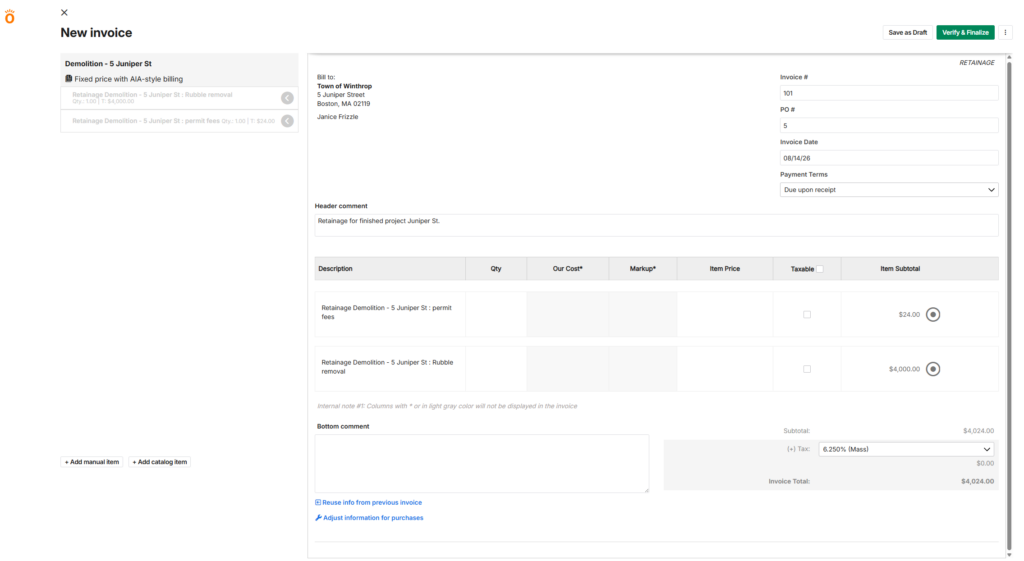
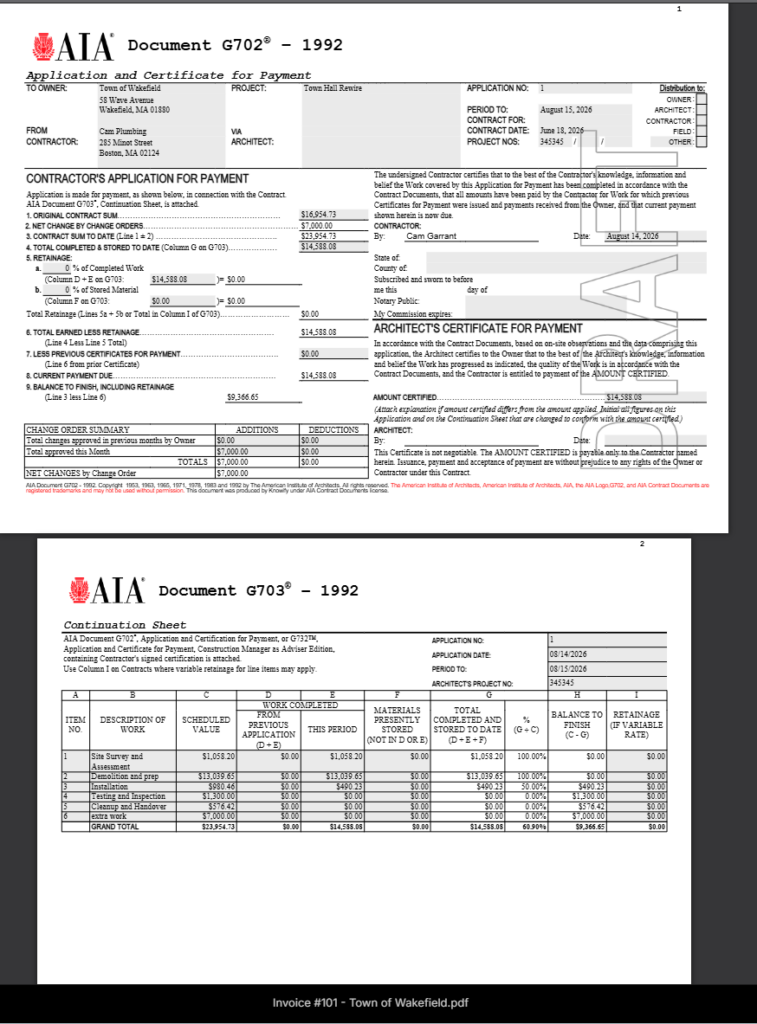
A real AIA pay application is two documents:
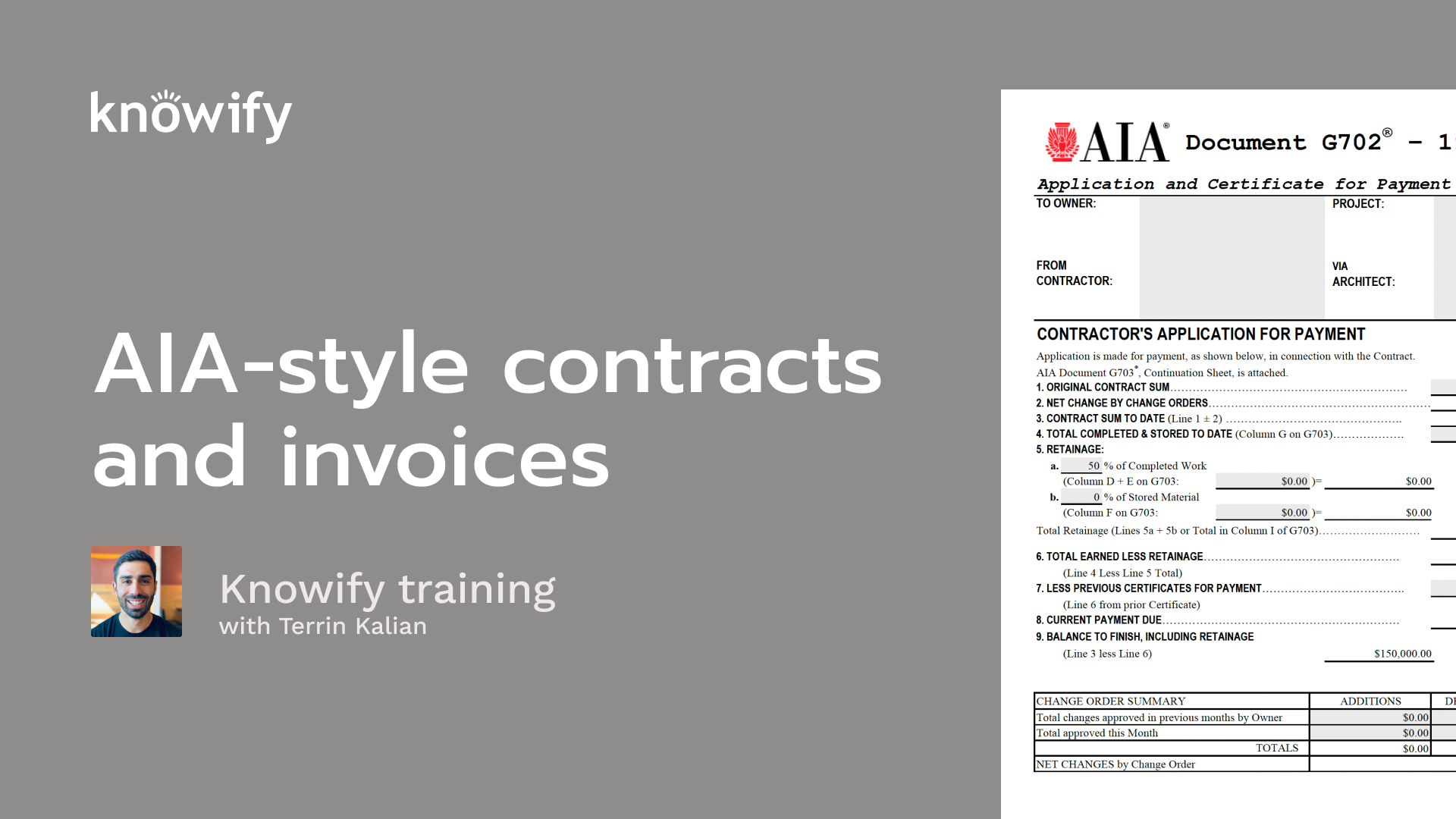
On its IES product pages and release notes, Intuit consistently says “AIA-style,” not AIA billing. Here’s Intuit’s description: “The new AIA-style invoicing format in Intuit Enterprise Suite can track the total contract value on estimate, invoiced to date, invoice amount, and remaining balance at the phase level.”
Four fields, at the phase level. Note Intuit’s verb is “can track.”
What that structure does not carry:
G702 and G703 appear nowhere across Intuit’s construction page, its release notes, or the press release. RedHammer is asking for native G702/G703 generation from the WIP report as of May 2026.
If your owner or GC requires the G702/G703 package, IES gets you a phase-grouped progress invoice and you build the rest somewhere else. A 3rd party tool like Knowify can make the pay app creation process much easier, while also providing real forms G702 and G703.
Knowify creates official branded G702 and G703 forms through Knowify’s partnership with AIA Contract Documents, with the schedule of values, stored materials, retainage tracked by phase, percent complete, and change order reconciliation, including warnings when you’re about to bill a change order in the wrong billing period. On all three plans.
“The AIA billing feature is amazing. It’s something that used to take me eight hours, but I can do it in virtually eight minutes now.” – Clint Chaney, Owner, Chaney Mechanical. Read the full case study
IES tracks completion at the project level, entered in the office. RedHammer is asking Intuit for “a true percent-complete engine supporting cost-to-cost and units-of-production methods,” which tells you the methods aren’t there yet.
Knowify tracks units of progress at the phase level, and foremen and timecard approvers can mark phase progress from the mobile app’s daily logs along with photos and comments. Nothing reaches the project record from the job site without using a 3rd party app.
No IES field app exists for crews. QuickBooks Time gives you mobile clock-in by project and task, and there’s mobile receipt capture for Intuit Mastercard purchases, so “no mobile at all” would be wrong. What doesn’t exist is a way for the field to push photos, daily logs, or phase progress into the project record automatically.
In practice that means somebody in the office re-enters what the field reported by text, photo, or phone call.
“We knew years ago that we needed some sort of business software because I need to be able to run one day service jobs, and projects that take up to a year. No one had the list of features I needed, except Knowify.” – Nathaniel White, Owner, White Bros. Plumbing. Read the full case study here.
WH-347 generation shipped in May 2026, so certified payroll is no longer totally absent.
One structural note: Intuit’s help documentation lists certified payroll eligibility as QuickBooks Workforce Elite or Workforce Premium, so it rides on a Workforce payroll subscription rather than the IES accounting core.
Intuit now bundles Workforce Elite into IES, so for most IES customers this is included rather than a separate purchase.
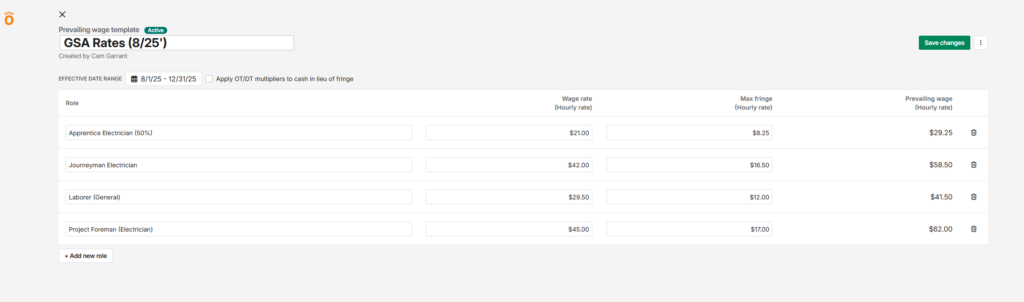
What’s missing: prevailing wage rate libraries by locality, fringe benefit accrual tracking by job and worker class, and union reporting templates. A WH-347 generator without a rate library means you maintain rates and fringes outside the system and hope the report matches. Users of Intuit Enterprise Suite that have state level prevailing wage work will want to look for a 3rd party system to handle their labor rate tracking and payroll processing to stay compliant.
Knowify’s prevailing wage add-on defines labor classifications, wage rates, and fringe benefits project by project, captures job classifications when employees clock in and out from the jobsite, assigns prevailing wage labor cost to the right phase without waiting for payroll, and integrates directly with construction-specific certified payroll providers like Lumber and eBacon.
Intuit Enterprise Suite allows users to bill time and materials through billable time and expenses with markup. What doesn’t exist is T&M, cost-plus, or unit price as first-class contract types wired into estimating, job costing, and progress billing. The methods IES names are percentage-of-completion and milestone. Trade contractors running a mix of billing methods and contract types will need to manage the difference by hand.
Users with mixed contract needs should look for a 3rd party platform like Knowify, which treats fixed price, unit-based, cost-plus, time and materials, and AIA as structured contract types from estimate through final billing.
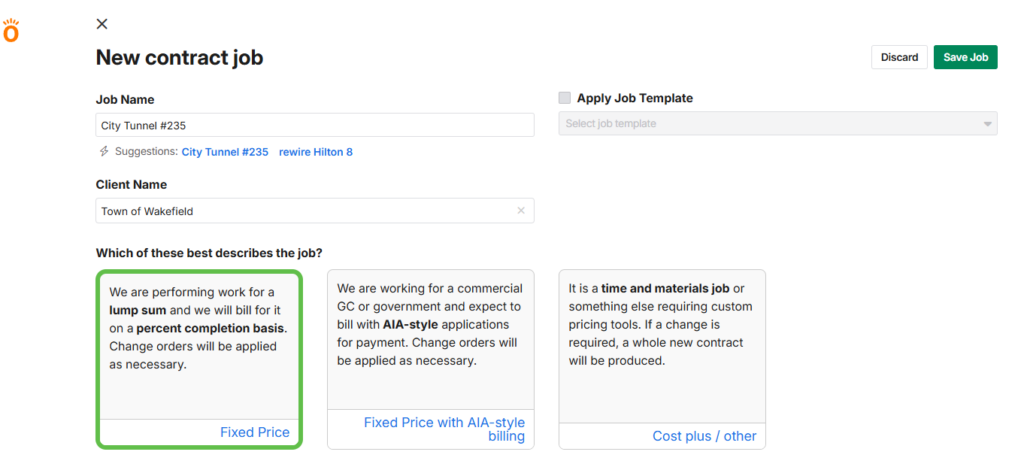
We found no Intuit documentation for any of the following:
If the above are needed for the business, look for a supporting platform like Knowify which provides drag-and-drop scheduling for employees, subcontractors, and equipment. RFIs, submittals, document markup, and more.
IES acts as an accounting, ERP, and HR platform. The documentation shows no support for:
Contractors who run service work alongside their projects will
IES has a client portal, confirmed in Intuit’s February 2026 release notes – it handles proposals, e-signatures, and deposits.
*Knowify’s client portal shows project progress broken down by phase, by percentage or units of measurement, using whatever the team tracked on the job, through a unique secure link so the client never has to sign up or log in. It also allows you to show or hide contracts, invoices, change orders, photos, notes, and more.
Everything above is why IES alone is usually an incomplete fit for a single-entity trade contractor. Here’s the other side, held to the same sourcing standard.
Multi-entity consolidation with automatic intercompany eliminations solves a problem construction platforms leave alone. Knowify does not consolidate financials across legal entities. Neither does any purpose-built construction platform in this price range.
The construction reviewers who consolidate entities are emphatic about it.
“The biggest reason why we went to Intuit Enterprise Suite was so we didn’t have to prepare manual consolidated financial statements anymore.” And, on alternatives: “Overall, I would choose Intuit Enterprise Suite over NetSuite ERP every time.” – John Michael Henne, CFO, Midwest Landscape Industries. 9/10 on TrustRadius, November 2025. Construction industry reviewer.
A controller at a 51-200 employee construction firm goes further, and on support, which is a category IES gets criticized for elsewhere.
“They have the best support. Quickbooks has always had great support but they have stepped it up a level for help with Intuit Enterprise Suite. They are always there to help by phone, chat, and appointment.” And: “All in all we have been very happy switching to Intuit Enterprise Suite, so much so that we renewed for three years.” – Darla Hennessey, Controller, Lallier Construction Inc. 10/10 on TrustRadius, November 2025. Construction industry reviewer.
“IES is well suited for multi-entity organizations. If the intercompany mapping is set up correctly, the access to consolidated reporting can be a game-changer.” – Spencer Graham, Management Accountant, Lopp Construction. 8/10 on TrustRadius, July 2026. Construction industry reviewer.
The same reviewer draws the line where we’d draw it: “IES is less appropriate for smaller companies or companies with only one entity. The price tag is high.”
So if you consolidate multiple legal entities, IES earns its quote. Pair it with a construction platform and you have a strong setup. If you run one entity, you’re buying an unpriced enterprise accounting platform, plus implementation, to reach construction features still in open beta. Which of those two you are is the question worth settling before you take the sales call.
As of August 5, 2026:
| Platform | Score | Volume |
|---|---|---|
| G2 | 4.6 out of 5 | 41 reviews |
| TrustRadius | 9.1 out of 10 | 47 reviews and ratings |
| Gartner Peer Insights | 3.8 out of 5 | 6 ratings |
Two caveats on those numbers. TrustRadius shows 38 written reviews in its full-list view, so the 47 appears to include ratings-only submissions. And four of the six Gartner reviews sit behind a login.
Volume is modest either way. At these counts a single review moves an average, so read the reviews themselves rather than the score.
TrustRadius lets you filter to construction, which returns nine reviews, and that set splits hard: three 10/10s, a 9/10, two 8/10s, an 8/10 from an enterprise employee, a 4/10, and a 1/10. Here is what both ends say.
Consolidation is the theme, without exception, among the high scorers. Croxall on replacing multi-platform data pulls, Hennessey on several companies under one roof and renewing for three years, and Henne on retiring manual consolidated statements are all quoted above. An operations manager adds the daily-use view.
“The ease of access to knowledge and the ability to ask for help is unparalleled. You can see your finances and projects all at once and can manage your team with all the reports that are made available to you.” – Douglas Brown, Operations Manager, CalData Communications. 10/10 on TrustRadius, October 2025. Construction industry reviewer.
On migration, a construction president reports a non-event.
“As a user of QBO the transition to Intuit Enterprise Suite was seamless. The switch happened overnight and we did not notice any changes from what we were using in QBO. There is minimal training involved for our staff in upgrading to Intuit Enterprise Suite.” – Michael Panster, President, Servpro of Ft Lauderdale. 8/10 on TrustRadius, November 2025.
And on time saved and cost, from G2.
“Extremely good and affordable multi-entity software. Intercompany transactions and consolidated reporting are a breeze. It saves me hours of Excel work every month, and it costs a fraction of the price of its competitors.” – Byron R., CFO, Small-Business. 4.5/5 on G2, July 2026. Not construction-specific.
“Since implementing the Intuit Enterprise Suite (IES), I have saved approximately eight hours per week on data entry and reconciliations.” – Crystal H., Executive Accounting Manager, Enterprise. 5.0/5 on G2, February 2026. Not construction-specific.
The harshest construction review on the platform gives IES a 1 out of 10, and it has no pros section at all.
“Reporting needs to be simplified.” “Bank feed needs to be improved.” “Projects functionality is full of bugs and works very poorly.” And: “I would not recommend IES, it does not work any differently or better than the lower cost version of Quickbooks and training materials are hard to find.” – Verified User, Executive in Finance and Accounting, construction, 11-50 employees. 1/10 on TrustRadius, April 2026.
The 4/10 is more mixed, and worth reading in full because it credits things too. Its pros include “The layout of IES is fairly simple to navigate,” “Reports are helpful when having multiple entities,” and “Business at a glance is a nice feature to have when reviewing all the companies.”
Its criticism: “Updates are clunky. They do not always work and/or when an update is done it makes something else in the system that was working properly not work. Updates to the system do not produce all that was promised in the release notes.” And: “IES feels pieced together as opposed to one system that works in conjunction with all the entities.” – Verified User, C-Level Executive in Finance and Accounting, construction, 201-500 employees. 4/10 on TrustRadius, July 2026.
On construction reporting and the bill-reading AI, from the 8/10 reviewer who otherwise recommends IES for multi-entity work:
“Construction project reporting is not as good as it was in QuickBooks Desktop Enterprise.” And: “The AI model(s) they use to read bills are not very good at it.” And: “Some workflows are not customizable when they should be, such as intercompany invoicing and paying bills.” – Spencer Graham, Management Accountant, Lopp Construction. 8/10 on TrustRadius, July 2026. Construction industry reviewer.
The AI complaint is the loudest recurring one, and it shows up even in an 8/10.
“AI- it’s pretty much always wrong and not useful for pretty much anyone I know. I view it as a hindrance to my workflow and would prefer it be an option to toggle off and not have to deal with anymore.” – Verified User, Employee in Finance and Accounting, construction, 5001-10,000 employees. 8/10 on TrustRadius, November 2025.
From G2, on migration cost and performance:
“The implementation was more challenging than expected, and several core features we relied on in QuickBooks Desktop were either missing or not fully developed. We also experienced integration issues, permission limitations, reporting gaps, and workflow disruptions that affected our daily operations.” – Lisa L., Operations Manager and Partner, Small-Business. 3.0/5 on G2, July 2026. Not construction-specific.
She adds that ROI “has been lower than anticipated because of the time and additional costs involved.”
“The biggest pain point is the speed and performance when working with large datasets. If we run complex, detailed reports over a long date range, or have many users logged in at once, the system can lag or take a long time to load. It’s manageable, but slower than we’d expect for a paid enterprise solution.” – Bo L., Brand Strategy Coordinator, Mid-Market. 3.5/5 on G2, March 2026. Not construction-specific.
Two reviewers who rate IES highly still flag the release cadence. Elaine S., a controller at 4.5/5 in July 2026, wrote that “Intuit Enterprise Suite updates every few months, and sometimes those updates ‘break’ things in ways that are hard to figure out how to correct.” And a small-business construction reviewer who gave IES a perfect 5 out of 5 in April 2026 wrote that “intercompany billing and the forwarding email for bills, still feel green and haven’t worked reliably for us,” and that “sometimes it feels like new features are pushed out before they’re ready for real-world use, which means I end up doing things manually.”
Intuit publishes at least three versions of one statistic:
For context on the ERP comparison Intuit draws, per implementation partners: mid-market Sage Intacct commonly runs three to six months from kickoff to go-live, and NetSuite roughly four to six months mid-market and six to twelve for complex multi-entity. IES being meaningfully faster is credible.
Read for yourself: G2 · TrustRadius, filtered to construction · Gartner Peer Insights
Reflects Intuit’s Spring 2026 release, observed August 5, 2026. Construction Edition is an open beta for IES customers and changes release over release.
| Knowify | Intuit Enterprise Suite | |
|---|---|---|
| Core accounting and general ledger | Integrates with QuickBooks | Yes, native |
| Multi-entity consolidation and intercompany eliminations | No | Yes, transaction-level, June 2026 |
| Dimensional reporting | Passes IES Dimensions through per job, does not report on them | Yes, up to 20 dimensions, plan-dependent |
| Integrated payroll and HR / HCM | Via QuickBooks | Yes, Workforce Elite, bundled into IES |
| Certified payroll (Form WH-347) | Enterprise add-on for labor tracking , full certified payroll via Lumber/eBacon | Yes, May 2026, via Workforce Elite or Premium |
| Financial planning, forecasting, scenario modeling | No | Yes |
| Peer benchmarking against real business data | No | Yes, beta |
| Inventory | Paid on Core and Advanced, included on Enterprise | Deeper: POs, sales orders, item receipts, moving average cost |
| Knowify | Intuit Enterprise Suite (beta) | |
|---|---|---|
| Job costing | Yes | Yes |
| Project phases and budgets | Yes | Yes |
| Estimating | Yes | Yes |
| Change orders | Yes | Yes, negative COs at estimate level only |
| Real-time WIP with over/under billing | Yes | Yes, enhanced Spring 2026 |
| AIA-style progress invoicing | Yes | Yes |
| AIA G702 and G703 forms | Yes, all plans, via AIA Contract Documents partnership | No |
| Retainage / retention | Yes, tracked by phase on the pay app | Negative line item plus custom Retention Receivable/Payable accounts |
| Stored materials on pay applications | Yes | No |
| Percent-complete engine | Yes, units of progress by phase, Advanced+ | Project-level, entered in office |
| Cost-plus and T&M as contract types | Yes | Billable time and expenses with markup |
| RFIs and submittals | Yes | No |
| Drawing and plan markup | Yes | No |
| Crew, sub, and equipment scheduling | Yes | No; QuickBooks Time covers field timekeeping |
| Prevailing wage rate library, fringe by class, union templates | Yes | No |
| Knowify | Intuit Enterprise Suite | |
|---|---|---|
| Service scheduling and dispatch | Yes, Service Pro add-on | No |
| One-time and recurring service jobs | Yes | No |
| Live service map and routing | Yes | No |
| Mobile app for crews and techs | Yes | No; QuickBooks Time or 3rd party |
| Field-captured photos, daily logs, phase progress | Yes | No |
| Client-facing production view | Yes | Proposal and e-sign portal only |
| Knowify | Intuit Enterprise Suite | |
|---|---|---|
| Built for | Trade and specialty contractors | Mid-market multi-entity finance teams |
| Pricing | Published: $99, $329, and custom per month billed annually | Quote-based, not published |
| Free trial | Yes | No |
| Implementation | Unlimited onboarding and training | Intuit consultant manages the migration |
How many legal entities do you consolidate? This is the first question, not the last, because it decides whether IES belongs in your stack at all. One entity points away from choosing IES, and IES’s own construction reviewers say so: the Servpro president on QBO with one or two instances, and the Lopp Construction accountant on IES being “less appropriate for smaller companies or companies with only one entity.” Managing several entities? That points squarely at it.
Do you run project work, service work, or both? “Both” is the strongest tell for a construction platform. A shop doing phased construction plus service or maintenance calls is the case neither an accounting platform nor a pure field-service tool covers alone.
How do you bill? If commercial or public owners require G702 and G703 with retainage and stored materials, you need the real forms. If simple progress, T&M, or fixed-price billing covers you, your options widen.
Who owns your books? An in-house finance team running consolidations and dimensional reporting pulls toward IES. A shop leaning on an outside ProAdvisor or CAS firm, with the work itself as the priority, pulls toward a construction platform on QuickBooks.
How much of the work happens in the field? Crews and techs who need mobile access, photos, daily logs, phase progress, and dispatch need a field-capable tool.
How much manual process can your office absorb? Retention as a negative line item, percent complete in a spreadsheet, field progress re-entered from text messages, and prevailing wage rates maintained outside the system are each survivable alone. Stacked, however, they’re a full-time job you’re already paying for.
Knowify + QuickBooks Online fits a single-entity or simple-structure trade contractor running project work, service work, or both, who needs real G702 and G703 pay apps with retainage, wants crews working from a mobile app, and prefers published pricing and a trial they can start today.
Knowify and IES together fits the business with the multi-entity consolidation needs that IES solves for, and the field, service, and AIA billing needs only a construction platform solves. IES stays as the financial system of record, Knowify runs the work, and job data flows up.
IES on its own fits a multi-entity, finance-led business whose construction billing is satisfied by basic progress billing, with no service department and field execution handled outside the system. You get consolidation, dimensional reporting, benchmarking, and HCM in one place.
Look wider if your situation points past both:
If you run both, here’s what connects. Our IES integration is two-way, and it has everything our QuickBooks Online integration has plus more.
This is our published QuickBooks Online sync list, which is the accurate baseline for what the IES connection carries.
Both directions:
Knowify to QuickBooks:
QuickBooks to Knowify:
On IES specifically, Dimensions replace classes, which is one reason to talk through your own field mapping with our team during setup rather than assuming the QBO list maps one to one.
For companies on IES with Dimensions enabled, you open a job, go to Job Defaults under QuickBooks Mapping, and set the Dimensions once. From then on, all invoices, bills, and other synced transactions created under that job automatically include those Dimensions.
One caveat: when new Dimensions are added in QuickBooks you click Sync Now and update your job defaults, so it isn’t one-and-done forever.
You connect each business and run its projects in Knowify. IES consolidates financials across entities, Knowify consolidates the projects.
We publish our pricing. As of August 5, 2026:
| Plan | Annual ($/mo) | Monthly ($/mo) | Users |
|---|---|---|---|
| Core | 99 | 149 | 1, plus $29/user/mo |
| Advanced | 329 | 399 | 10, plus $29/user/mo |
| Enterprise | Custom | Custom | Unlimited |
Add-ons:
What each tier adds:
AIA pay applications with G702 and G703 is on all three plans.
Monthly billing has no contract and you can cancel any time. Annual is billed once a year at a discount.
Source: knowify.com/pricing.
Intuit publishes nothing. No price list, no tiers, no seat counts, no self-serve signup. You get a number from Intuit’s sales team or a certified implementation partner who scopes a quote.
Three things seem to drive pricing, based on market data: entity count, seat count, and which modules and integrations you turn on. Implementation is usually separate, though Intuit covers it for QuickBooks Desktop migrations and calls it a $9,000 value.
To compare on equal footing, ask for the all-in first-year number: subscription, per-user seats, implementation, and module add-ons. Then ask two more questions:
Sources: erp.intuit.com/pricing and erp.intuit.com/migration.
“Knowify continues to have stellar customer service, and speedily respond to customer needs. They are true partners, and are right there to help us when we need things like a customized report.” – Sully S., Knowify customer, on G2
“We utilize Quickbooks Online for our accounting software and that was one of the reasons we signed with Knowify since the two are integrated.” – Danielle M., Knowify customer, on G2
“Job Costing information and how it’s displayed. We can see at a glance how we are doing at any point in the job. Integration with QuickBooks. QuickBooks doesn’t have the job costing abilities we needed, but we need to use it for our accounting.” – Cindy S., Operations, Knowify customer, on G2
To see Knowify in action for yourself, request a demo, or start a free trial.
IES is Intuit’s cloud financial management platform for mid-market businesses that have outgrown QuickBooks Online but don’t need a full traditional ERP. It runs on QuickBooks Online’s infrastructure as a distinct product, adding multi-entity consolidation with automatic intercompany eliminations, up to 20 reporting dimensions, AI agents, integrated payroll and HR through QuickBooks Workforce, peer benchmarking in beta, and industry-specific capability, with construction as the first vertical build. Intuit does not publish a target revenue range.
No. IES is built on QuickBooks Online’s infrastructure but is a separate product from both. It adds multi-entity management, dimensional reporting, and AI automation neither QuickBooks product supports natively. Businesses moving from QuickBooks Desktop Enterprise should know that Desktop-only inventory functionality does not carry over, including serial and lot number tracking, barcode scanning, and sales orders with backorder control.
Yes. IES Construction Edition, in open beta for IES customers since February 2026, includes job costing, project phases and budgets, estimating, change orders, an enhanced WIP report with over and under billing, cost-to-complete reporting, WH-347 certified payroll, and AIA-style progress invoicing. It does not produce AIA G702 and G703 forms, has no native retainage field, and has no field service dispatch or field app for crews. Reviewer experience with the Projects module is split, from a 5 out of 5 on G2 praising its accuracy to a 1 out of 10 on TrustRadius calling it buggy.
On its IES product pages and release notes, Intuit describes the capability as AIA-style progress invoicing: a phase-grouped invoice that can track total contract value on estimate, invoiced to date, invoice amount, and remaining balance. It does not carry the fields a G702/G703 package requires, including a retainage column, materials presently stored, percent complete, or a G702 summary and certification section. RedHammer, Intuit’s select construction implementation partner, was still asking Intuit for native G702 and G703 generation as of May 2026. Knowify produces those forms today.
There is no native retainage field. The documented method, which Intuit’s own community moderators prescribe for QuickBooks Online, is to enter a retainage item as a negative amount against a Retention Receivable asset account, with a mirroring Retention Payable liability account on the AP side, then track and release retention manually. RedHammer is still asking Intuit for retention handled as a built-in field rather than a workaround.
For IES customers, yes. As of August 5, 2026 Intuit’s construction page describes it as available in open beta, and Intuit’s beta terms state that features in beta are subject to change or discontinuation at any time and that Intuit may introduce fees for them in the future. The same capabilities are generally available as a paid add-on for QuickBooks Online Advanced customers.
Intuit does not publish IES pricing. It is sold by custom quote based on entity count, seat count, and which modules and integrations you turn on, with implementation usually separate, though Intuit covers implementation for QuickBooks Desktop migrations and calls it a $9,000 value. Third parties estimate implementation starting around $7,000 and annual cost from roughly $7,800 for a single entity to $12,000 or more for multi-entity, but those are not Intuit figures. Reviewer opinion on value splits: one construction reviewer says “the price tag is high,” while a CFO on G2 calls it “a fraction of the price of its competitors.”
Roughly every three to four months: September 2024 launch, December 2024, Spring 2025, Summer 2025, Fall 2025, February 2026 for the Construction Edition beta, and Spring 2026 in May. As of August 5, 2026 there is no Summer 2026 IES release. Intuit’s August 4, 2026 Summer release covered QuickBooks and Intuit Accountant Suite instead. Several reviewers who rate IES highly still note that updates occasionally break working functionality.
Intuit positions it that way for many mid-market businesses, publishing figures of 90% and 95% of customers set up in under 30 days. Implementation partners put mid-market Sage Intacct at three to six months and NetSuite at four to six, so a meaningful speed advantage is credible. Customer accounts run both ways: one construction president describes a transition that happened overnight, while a Gartner reviewer in education called their implementation “awful” before praising the support team that rescued it. Whether it replaces an ERP depends on the business, with inventory depth the clearest limitation.
No, and it is not meant to be. IES is an accounting and ERP platform. Knowify is construction operations software that integrates with QuickBooks and connects to IES, and it does not consolidate financials across legal entities. Contractors use Knowify for the field, service, and AIA billing work IES does not cover, and many run both.
As of Intuit’s Spring 2026 release: AIA G702 and G703 pay application forms, retainage tracked by phase on the pay application, stored materials, phase-level progress captured from the jobsite, service scheduling and dispatch, recurring service jobs, a live service map, a mobile app for crews and techs, crew and equipment and subcontractor scheduling, RFIs and submittals, plan markup, and prevailing wage rate definitions with fringe by classification.
Multi-entity consolidation with automatic intercompany eliminations, dimensional reporting across up to 20 dimensions, integrated payroll and HCM, financial planning and scenario modeling, peer benchmarking against real business data, and deeper inventory. If you need those, IES is doing something Knowify does not.
Yes. Knowify has connected to IES since January 2025, and Intuit lists Knowify as an integration partner on its construction page. The integration is two-way, covering clients, vendors, subcontractors, items, expenses, bills, and payments, sending invoices and time up from Knowify, and carrying IES Dimensions through on the transactions it creates once you map them per job.
Mid-market businesses that need enterprise accounting across multiple legal entities, consolidated financials, dimensional reporting, and integrated payroll and HR. If that’s your need and your construction requirements are covered by AIA-style progress billing, IES is a strong fit, and its multi-entity construction customers say so publicly.
Trade and specialty contractors who need to run project and service work, want crews and techs on a mobile app, and need AIA G702 and G703 pay applications, at published pricing they can try free.
Reviewers most often praise multi-entity consolidation with automatic intercompany eliminations, dimensional reporting, ease of use relative to NetSuite and Viewpoint ProContractor, cloud access for teams coming off QuickBooks Desktop, and time saved on reconciliation and consolidated statements. The most common criticisms are the bill-reading AI, construction project reporting weaker than QuickBooks Desktop Enterprise, custom reporting limits on consolidated views, slowdowns on large datasets, and updates that break working functionality. Support experiences split sharply, from “they have the best support” to multi-hour calls without resolution. For contractors specifically, the construction tools are in open beta, there is no native retainage field, no G702 or G703 forms, no field app for crews, and no field service management. Review volume is still modest across all three platforms, so read the individual reviews rather than the averages.