Choosing the best software for electrical contractors is less about finding a single “winner” and more about matching a tool to how your shop actually works and bills. A residential service company and a commercial subcontractor filing AIA pay applications have very different needs. This guide walks you through how to evaluate your options by financial workflow, contract type, and business size, so you can shortlist with confidence and pick a system you will actually use.
Getting the job done well has never been the hard part for skilled electrical contractors. Getting paid on time, knowing whether a job made money, and keeping the office and field in sync are where good shops lose margin. According to the U.S. Bureau of Labor Statistics, electrician employment is projected to grow 9% from 2024 to 2034, much faster than the roughly 3% average for all occupations, with about 81,000 openings each year. Demand is strong, but crews are tight. The best software for electrical contractors is the tool that helps you capture that demand and keep every job profitable, not the one with the longest feature list.
The electrical trade is in an unusual spot: plenty of work, not enough hands to do it. The U.S. Bureau of Labor Statistics reports about 818,700 electricians employed in 2024, with that 9% growth outlook and roughly 81,000 openings per year over the decade. Most of those openings replace retiring workers rather than adding net-new crews. Electrification, EV charging, data-center construction, and grid modernization keep the phone ringing. When you cannot simply hire your way to more capacity, operating efficiently becomes the way to grow.
That pressure lands hardest on small shops, because most electrical firms are small. NECA’s 2024 Profile of the Electrical Contractor found that 51% of firms employ 1 to 9 workers and 42% generate under $1 million in revenue. In shops that size, the owner or a single office manager carries the estimating, invoicing, and bookkeeping. Every hour spent reconciling spreadsheets is an hour not spent bidding or billing. The same survey found 28% of firms increased headcount in the survey year, so many of these small shops are trying to grow and manage the admin load at once.
Disorganization is not just annoying; it costs real money. Citing the Construction Industry Institute, PlanRadar reports that rework consumes roughly 5% to 10% of total project costs across construction. PlanRadar also notes, drawing on PlanGrid, FMI, and Autodesk research, that 14% to 22% of rework traces back to bad or inaccurate data. When your field notes, your budget, and your books live in separate places, that gap is where errors and lost margin hide.
The root cause is the same at any size: fragmented information and poor real-time visibility. When your estimate, your field data, and your books do not talk to each other, problems surface only after a job has already slipped. Software that keeps your numbers connected is how you stay profitable, stay on track, and stay organized.
Electrical contractor software falls into a few broad categories, and the right fit depends on which part of your business hurts most. The table below summarizes how the main categories compare, so you can see where each one starts and stops.
| Software category | Best at | Common gap |
|---|---|---|
| Field-service / CRM tools | Scheduling, dispatch, mobile invoicing, customer records | Light on job costing and commercial billing |
| Estimating / takeoff tools | Fast, detailed bids and labor units | Often siloed from accounting and invoicing |
| Project & financial management | Job costing, budgets, AIA billing, WIP, QuickBooks sync | Less focused on high-volume service dispatch |
| All-in-one job management | Connecting estimate to job cost to invoice to payment | Depth varies widely by vendor, so verify each area |
Whatever category you lean toward, the following capabilities are worth checking one by one.
Fast, accurate estimating wins more work, but the real payoff comes when a winning bid becomes a job budget without re-keying anything. Many shops estimate in one tool and rebuild the numbers in another once the job starts. That gap wastes time and invites the data errors that drive rework.
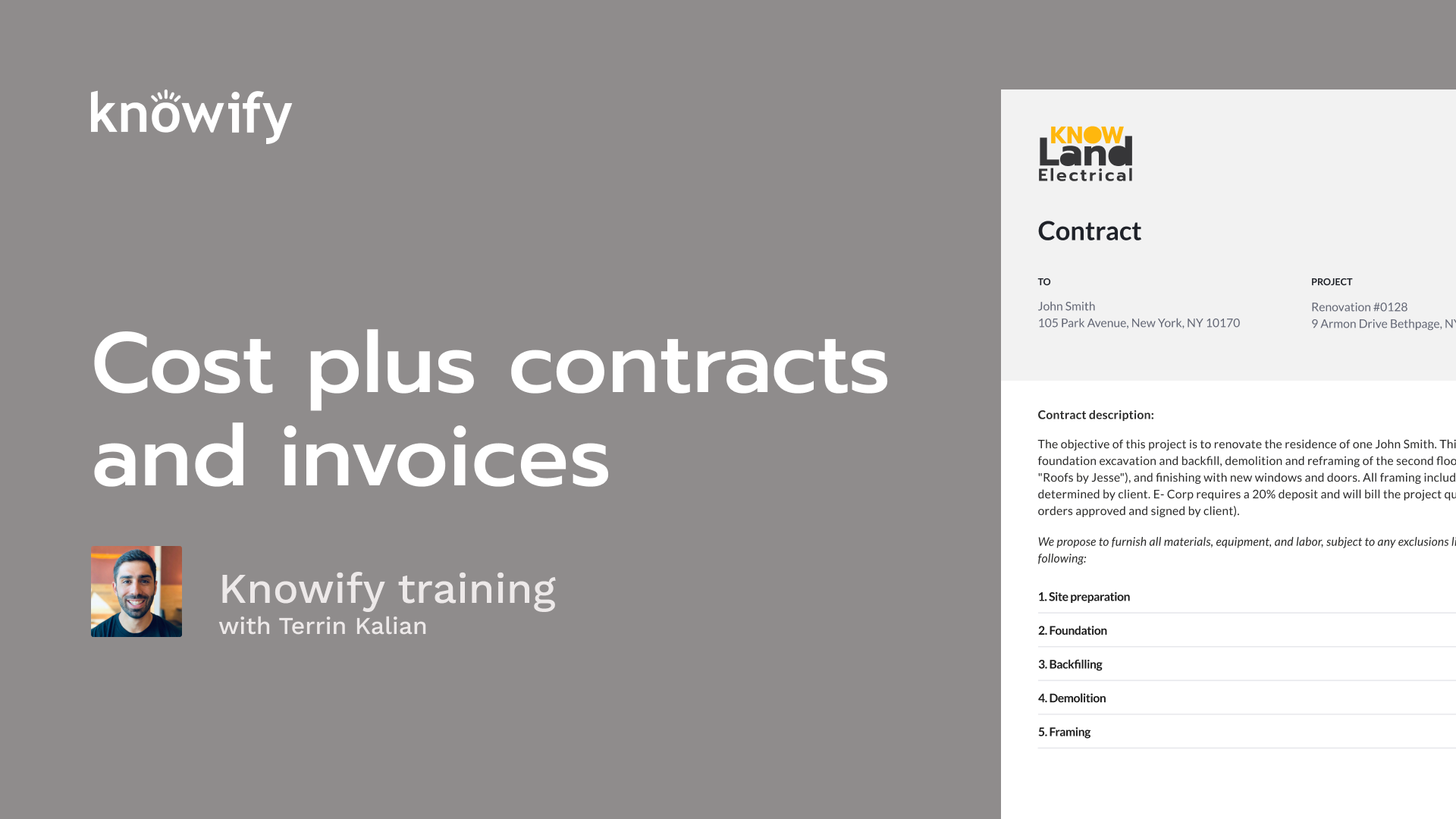
Look for template reuse for common job types so you are not rebuilding a service-panel upgrade from scratch every time. Just as important, ask whether the estimate carries straight into the job budget you will cost against. Knowify handles this as one workflow: build a professional PDF proposal, then turn it into a fully budgeted project plan the moment you win, with support for fixed-price, AIA-style, and cost-plus contracts.
This is the capability most listicles treat too lightly. You want to track labor, materials, subs, and equipment against your budget as you work, so you know projected profitability before a job closes, not weeks after. Pay close attention to how a tool handles the true cost of labor. A fully burdened labor rate includes base wage plus payroll taxes, workers’ comp, benefits, PTO, and overhead. According to payroll4construction.com, that burden typically runs 24% to 33% above base wage for non-union labor and 60% to 70% for union labor. Consider a simple example from payroll4construction.com: a $25 per hour base wage at a typical non-union burden of about 32% costs roughly $33 per hour once loaded. Bid that worker at $25 and you lose about $8 for every hour on the job. Across a full crew and a multi-week project, that gap turns an apparently profitable bid into a loss.
Budget on the base wage alone and you bury losses in every job. The tools that solve this track committed and actual costs against your budget in real time, then surface projected profitability and budget status while you can still act. Knowify’s real-time job costing budgets for the true cost of labor, tracks costs by phase and category, and shows WIP as the job moves.
Your crews are in the field, and your software should be too. Look for tools that let you assign work, notify techs on a mobile app, and sync field time and expenses back to the office in real time. The goal is fewer truck rolls and fewer trips back to the shop to sort out paperwork.
When a scope change happens on site, the field should be able to capture it without driving back for a new work order. That connection also feeds job costing: hours and material use logged in the field flow straight into the budget, so your profitability numbers stay current instead of waiting on end-of-week timesheets. For service teams especially, faster field-to-office sync shortens time to resolution and speeds up billing.
Getting paid faster is a direct margin protector. Strong invoicing software supports progress billing, one-click and mobile invoicing, and online ACH and credit card payments, so you can invoice from the site and get paid before getting back in the truck. Make sure the billing styles match your work: service tickets, progress billing on projects, and commercial pay applications are not the same thing, and not every tool does all three.
Nearly every vendor claims to “integrate with QuickBooks,” but depth varies enormously. A one-way export that dumps data into your books once a day is not the same as a two-way, real-time sync that keeps both systems current as you work. When the sync is shallow, someone still re-enters invoices, bills, and time by hand, which is exactly where errors and mistrust in the books creep in.
Ask whether the integration covers QuickBooks Projects and QuickBooks Payroll, and how it handles costs by job, category, and phase. Ask what actually flows between systems: purchase orders, bills, expenses, time entries, invoices, and payments. Knowify is built around the deepest QuickBooks integration in construction, a two-way real-time sync designed so there is no double data entry. Your team can work in Knowify while your accountant works in QuickBooks, and both stay current.
Most guides sort software by company size alone. That misses the bigger driver: the kind of work you do and how you bill for it. A fixed-price service shop, a growing contractor, and a GC-facing commercial sub each need different things. Match the tool to your work type first.
If most of your revenue comes from service calls and small residential jobs, prioritize speed and mobility. You want fast dispatch, mobile invoicing, and simple job costing that tells you whether a job paid off. Maintenance agreements are worth looking for too, since they generate predictable, recurring revenue.
The heavy commercial billing features do not help here; ease of use in the field does. A tech who can pull up the day’s jobs, log parts and time, and invoice from the truck keeps cash moving without a trip back to the office. If a tool is hard to describe or slow to learn, your crews will quietly work around it, and the data you were counting on never shows up.
As you scale, you often end up running both project work and service work at once. Managing them in two disconnected systems means double the training, double the admin, and a fractured view of your finances. New hires have to learn multiple tools, and every handoff between them is a chance for numbers to drift.
Look for one system that handles both, with scheduling that prevents double-booked or idle crews and real-time profitability so you can grow without losing financial visibility. Seeing every resource on one screen helps you avoid the client embarrassment of a missed or double-booked crew. This is the stage where “one system for all your project and service work” pays for itself, because the tool grows with you instead of holding you back.
If you invoice general contractors, your billing is a world apart, and most generalist tools simply skip it. You need AIA G702/G703 pay applications, a schedule of values, retainage tracking, overbilling alerts, RFIs, submittals, change orders, and WIP reporting. On public work, you also need labor burden built on prevailing-wage rates. The U.S. Department of Labor’s Davis-Bacon rules require locally prevailing wages plus fringe benefits on federally funded construction contracts over $2,000, so mis-estimating that burden erodes margin fast. Retainage deserves special attention: a portion of each progress payment is withheld until the project closes out, and that held-back amount can equal or exceed a project’s entire margin, straining cash flow until final release. Commercial work also runs on a paper trail. Change orders need a time-stamped record so you can invoice them accurately and defend them later, and RFIs and submittals need to be logged, searchable, and tied to the right phase. When those documents live in email and spreadsheets, disputes get expensive and billing slows down.
This is Knowify’s clearest strength. It produces actual AIA formatting rather than “AIA-style” output, generates the schedule of values, tracks retainage by phase, and flags overbilling in real time. It also keeps change orders, RFIs, and submittals inside the project lifecycle alongside budgets and invoices, so every request, response, and revision is time-stamped and easy to find.
If you are moving off older desktop accounting or ERP tools, or off spreadsheets entirely, your priority is modernizing without losing your data or looking unprofessional to GCs. Legacy systems often keep financials siloed and leave the field unable to update project data in real time, so the office is left guessing. That lag shows up in slow, error-prone bids and in pay apps that look dated to the general contractors you want to impress.
Look for a cloud platform with a strong QuickBooks integration, professional proposals and pay apps, and real-time field reporting. The aim is to send clean G702/G703 pay apps and modern proposals rather than PDFs stitched together from Excel. If you must keep an existing accounting system for now, confirm how cleanly the new tool works alongside it before you commit.
Pricing is one of the least-answered questions in this category, so here is a realistic range. According to FieldServiceGuide, field-service and contractor-management software for small teams of one to five techs typically runs $49 to $150 per month, while enterprise platforms start at $250 to $500 or more per month and increase from threre. These are early-2026 benchmarks, so confirm current pricing with each vendor.
Watch for what sits behind the headline price, too. Per-user pricing, add-on modules, payment-processing fees, and implementation costs all affect the real monthly figure. Ask what is included at each tier and whether the features you actually need, such as AIA billing or the QuickBooks sync, live in a higher plan.
The more useful way to think about cost is against the margin it protects. If a tool catches one underbilled change order or one job drifting over budget before it closes, it can pay for a year of subscription in a single save. Compare the monthly price to what one unprofitable job costs you.
Use this checklist to turn the framework above into a shortlist. Work through it before you sit through a single sales pitch.
There is no universal best; the right tool depends on your work mix, size, and billing. Service-heavy shops lean toward mobile-first dispatch and invoicing, while commercial subs need job costing and AIA billing. Start by defining your work type and required billing styles, then shortlist tools that connect your full financial workflow.
Small teams typically pay between $49 and $150 per month, according to FieldServiceGuide, while enterprise field-service platforms can reach $250 to $500 or more. Weigh the price against the margin the software protects on a single job rather than the monthly fee alone.
Many tools do, but depth varies widely. A one-way export is very different from a two-way, real-time sync that keeps both systems current and covers QuickBooks Projects and Payroll. If you run your books in QuickBooks, treat integration depth as a core buying criterion and ask exactly what syncs and how often.
Some vendors offer free trials or limited free tiers, which are useful for testing fit. Free versions usually cap users, jobs, or features, so they rarely support a growing shop for long. Treat a free plan as a way to evaluate the workflow, not as a permanent system for running your finances.
For small shops, prioritize speed and simplicity over enterprise depth. You want mobile time tracking, quick dispatch, easy invoicing, and job costing that syncs with your accounting so you are not entering everything twice. The best fit is a tool your crews will actually use in the field and that keeps your books accurate without late nights in spreadsheets.
You need software that produces true G702/G703 pay applications backed by a schedule of values, not a generic invoice styled to look like one. Look for automatic retainage tracking by phase, overbilling alerts, and stored-materials handling so you never double-bill. Knowify was built for this: it generates actual AIA formatting, tracks retainage as you bill, and keeps change orders, RFIs, and submittals connected to the project’s budget.
The best software for electrical contractors is not the one with the flashiest feature list; it is the one that fits how you work and how you bill. Match the tool to your work mix and contract types, prioritize a connected financial workflow from proposal to payment, and demand real depth in job costing and QuickBooks integration. Above all, choose a system your team will actually use in both the field and the office, because that is the one that keeps every job profitable. See how Knowify connects your full financial workflow: Request a demo.