Plumbing is a big, growing trade. The Bureau of Labor Statistics counts about 504,500 plumbers, pipefitters, and steamfitters working in the US, and it projects the field to grow 4% through 2034, with roughly 44,000 openings a year. The median annual wage sits at $62,970. That’s a lot of businesses trying to schedule crews, quote work, get paid, and still know whether each job made money.
The plumbing software you run your business on shapes all of that. So which tool is actually best? This guide gives you a straight answer: it depends on the work you do, and the smartest way to choose is to judge software on job costing, QuickBooks integration, and field reliability. We’re not contractors, but we work with them every day, and here’s how we’d sort it out.
There is no single best plumbing software. Anyone who tells you otherwise is selling one tool for every job. The better question is: which tool solves the problem you most need solved?
Every plumbing business needs software that does a few core things well. It has to schedule and dispatch crews, quote and invoice fast, help you get paid, track costs, and keep your books straight. But the weight you put on each one shifts with the work you do. A residential service shop running same-day calls has different needs than a commercial contractor billing a six-month pipe replacement in progress draws.
Here’s the trap: the fastest way to pick wrong is to buy for scheduling and ignore whether you’ll know if a job made money. Scheduling is visible and easy to demo. Profitability is where plumbing businesses quietly bleed. Lead with the money. That’s the lens we use at Knowify, financially-focused job management for the trades, and it’s the one that keeps contractors out of trouble.
Four criteria separate software that runs your business from software that just adds another screen. Weigh all four before you sign anything.
Job costing is not the same as bookkeeping. As Abacus Professionals notes, bookkeeping shows whether your business as a whole is profitable, while job costing shows which projects are actually driving that profit. Skip it and you risk what the construction industry calls “profit fade,” which occurs when the expected profit on a project decreases as work progresses.
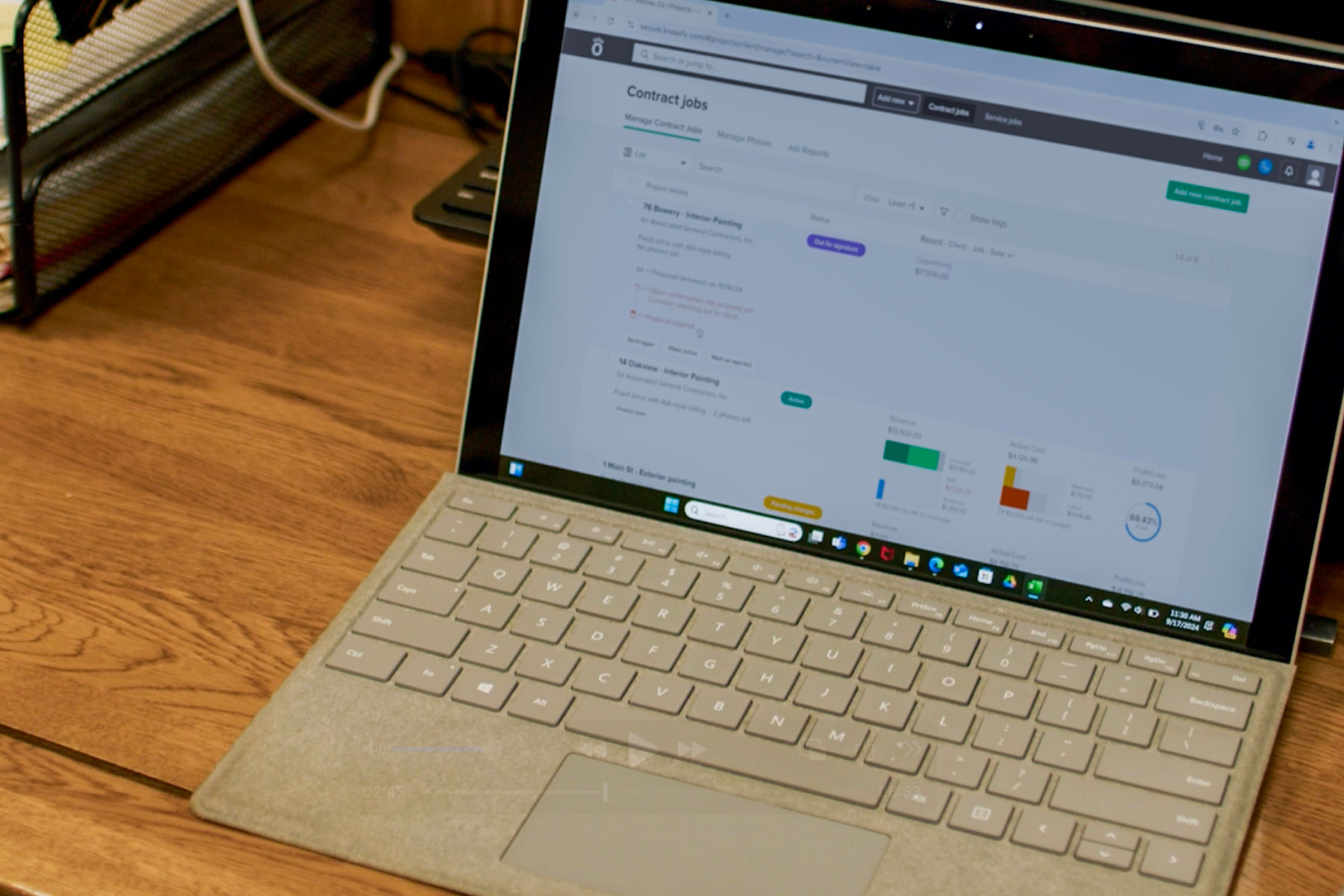
Labor cost adjustments and untracked change orders quietly accumulate into losses. And the timing matters. The same firm notes that a common mistake is waiting until the end of the month or the end of a job to review costs, and by then it’s too late to correct course. You want to see projected profitability while the job runs, not after. Knowify tracks job costs automatically from proposal to payment, so you know where every job stands at every stage.
QuickBooks dominates the books in this industry. According to ElectroIQ, citing Enlyft data, QuickBooks holds roughly 62% of the SMB accounting software market, and construction is the single largest industry segment of its users at 17.22%. Odds are good your books already live there.
The catch is that not all integrations are equal. Shallow ones still force you to enter the same invoice, bill, or time card twice, which wastes hours and breeds errors. Look for real-time, two-way sync of costs, invoices, and payments. Knowify is backed by the deepest, two-way QuickBooks integration in construction, so your project finances stay current in both systems with no double data entry.
Software only helps if your crew actually uses it on the job. That means mobile time tracking, mobile invoicing, and real-time sync between the field and the office, not a tool techs abandon by lunch.
Field reliability also drives cash flow. The Levelset 2020 Construction Survey found that, as of 2020, about 75% of construction contractors spent less than half their workday on actual construction, with the rest lost to paperwork and admin. That same survey put the construction industry’s days-sales-outstanding at roughly 83 days on a 2019 baseline. Both figures cover construction broadly, not plumbing specifically, but the lesson holds: admin and slow billing eat your time and your cash. Invoicing from the truck compresses that cycle. That’s the idea behind Knowify’s mobile invoicing, get paid before getting back in the truck, with the field synced to the office in real time.
Pure field-service tools are built for residential service calls. Project-focused tools are built for contract work. Plenty of plumbers do both, and running two systems to cover them is expensive and disconnected.
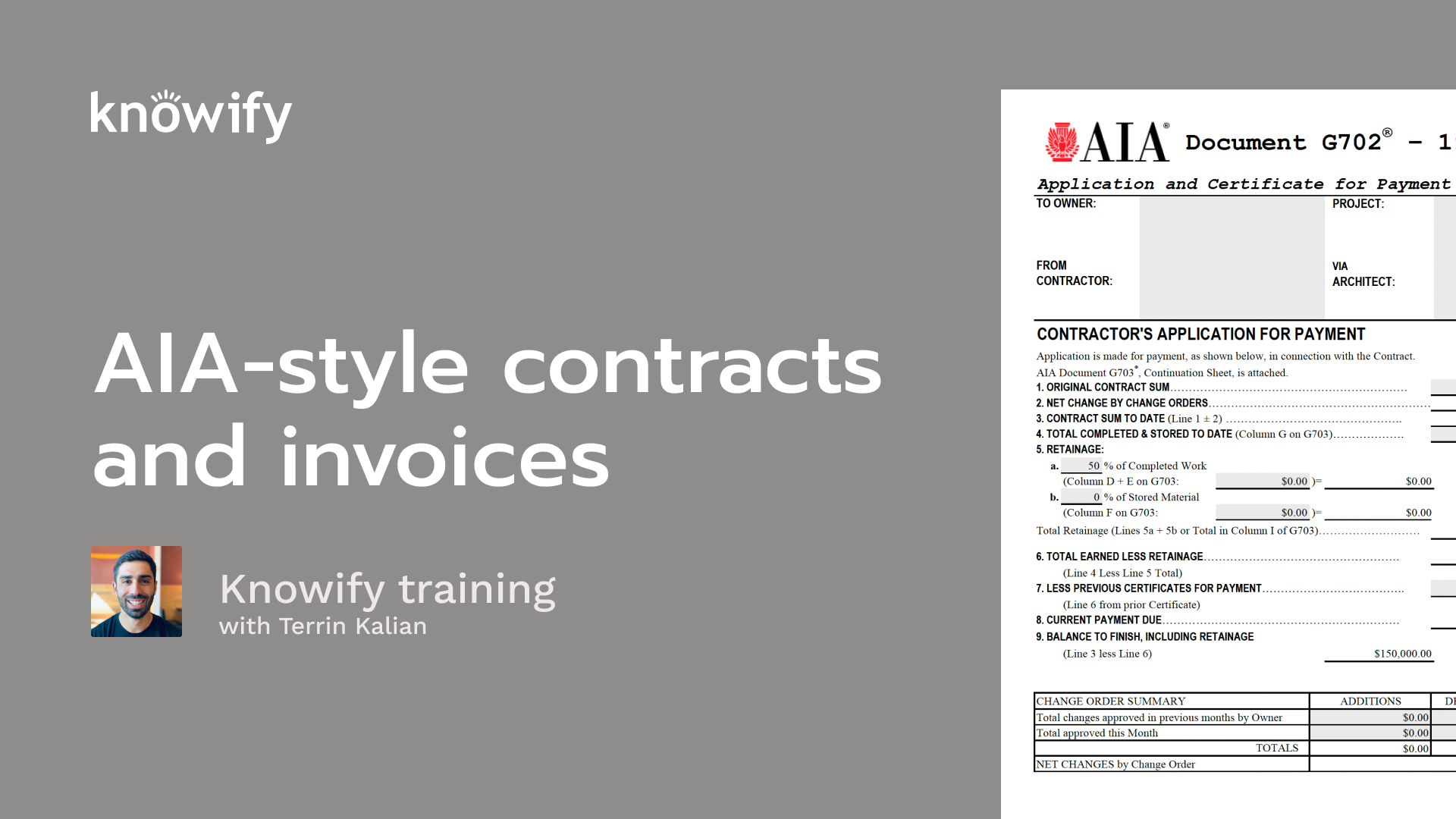
Commercial and contract work brings its own requirements: AIA-style G702/G703 progress billing, change orders, retainage, and WIP reporting. If you bid commercial jobs, you need those built in. Knowify manages service jobs and contract work in one platform, so a plumber running maintenance calls and a hospital retrofit can do both under one roof.
No single tool wins for everyone, so here’s an honest look at five popular options and who each one fits. The table gives you the quick view; the notes below add the detail.
| Software | Best for | Starting price | Job costing | QuickBooks sync | Service + contract work |
|---|---|---|---|---|---|
| Knowify | Trade contractors needing job costing and QuickBooks | $99/month | Real-time, phase-level | Deepest two-way sync in construction | Both in one system |
| ServiceTitan | Large enterprise service operations | Custom quote | Service-focused | Yes | Service-focused |
| BuildOps | Commercial-only contractors | Custom quote | Yes | Yes | Both (commercial) |
| Jobber | Small residential service shops | $39/month | Lighter | Yes | Service-focused |
| Contractor Foreman | Low-cost project management | $49/user/month | Yes | Yes | Project-focused |
Knowify is financially-focused job management software built for the trades. It tracks job costs and profitability in real time, from proposal to payment, and it’s backed by the deepest two-way QuickBooks integration in construction. It handles service jobs and contract work in one system, including commercial billing, AIA-style G702/G703 pay apps, change orders, WIP, and retainage. Plans start at $99/month, and it comes with award-winning onboarding and US-based support. If you want to know whether every job made money and keep your books in sync without double entry, this is the fit.
ServiceTitan is enterprise field-service management with deep analytics and dispatch, built for large plumbing operations with dedicated dispatch and admin staff. Pricing is per technician, and ServiceTitan doesn’t publish it publicly; you’ll only get a number through a custom quote. On Software Advice it’s rated 4.3 out of 5, with only 50% of reviewers rating its pricing positively. It’s powerful for big service teams, and priced for them too.
BuildOps is a cloud-based field-service platform built for commercial HVAC, plumbing, and electrical service businesses. It connects dispatch, scheduling, quoting, invoicing, and project management, and it integrates with QuickBooks. Pricing is by custom quote, and on Software Advice it’s rated 4.4 out of 5. It’s a strong fit for larger commercial service operations, though like other enterprise tools it doesn’t publish its pricing.
Jobber is known for ease of use and quick onboarding, which makes it a solid pick for small residential service businesses, roughly one to ten technicians. Pricing runs from $39/month for a single user up to $599/month for the Plus-Teams plan, and it earns a strong 4.6 out of 5 on Software Advice. The tradeoff: it’s lighter on advanced job costing and commercial or contract billing, so it fits simpler service work better than complex projects.
Contractor Foreman is a budget-friendly project management option, with per-user pricing tiers from about $49 to $332 per month. It offers project-based construction management with job costing and QuickBooks integration. The gaps show up in service work: reviewers note its scheduling can be confusing and it has no offline mode, so it’s a weaker fit for high-volume plumbing dispatch.
Turn the framework into a decision. Start with your work mix and revenue, because that tells you whether you lean service, contract, or both. Then list your must-haves, and put job costing, QuickBooks integration, and a mobile app your crew will use at the top.
Weigh total cost, not just the sticker price. “Free” or cheap software that forces manual workarounds costs you evenings and clean books, and that’s a real expense. Finally, run a demo using a real job from your business, not a canned example, and put both the office and the field in the room. The tool has to work for everyone who touches it.
There’s no single best. Pick by the job you most need solved, and weigh how well the tool tracks job profitability and syncs with QuickBooks.
Many tools integrate, but depth varies. Look for real-time, two-way sync so you’re not entering the same data twice.
Only if it does real-time job costing. Many field-service tools focus on scheduling, not job-level profitability, so you’d find out too late.
It ranges from about $39 to $49 a month for entry plans up to custom enterprise pricing. Weigh the cost against the admin time you’ll save.
Free tiers can work to get started, but they usually cap users or jobs and cost you time in manual workarounds. Factor that time into the price.
The best plumbing software is the one that fits your work, and you find it by looking past the demo dazzle to four things: real-time job costing, deep QuickBooks integration, field reliability, and fit for your service and contract mix. Get those right and the software pays for itself in profitability and hours back in your week. If you want to see how Knowify handles all four for plumbing contractors, request a demo.